Quotessence
Home / Quotes / Quote by Eugene B. Sledge

Quote by Eugene B. Sledge

Work

With the Old Breed: At Peleliu and Okinawa

Browse quotes and source details for this work. more

Author
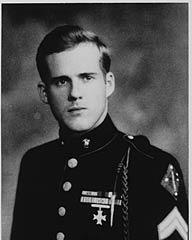
Eugene B. Sledge
Eugene B. Sledge

Eugene B. Sledge, born on November 4, 1923, was an American author known for his works centered around his experiences during World War II, particularly in the Pacific Theater. His writing, characterized by its raw and vivid depiction of war, has won him a wide readership. His most famous work, 'With the Old Breed: At Peleliu and Okinawa', offers a detailed account of his time in the battlefield, providing a poignant glimpse into the harsh realities of war and the bravery of soldiers. more

You May Also Like

“This cramped little space that stank of earth and smoke and sweat, that dripped water during every hard rain, and whose floor was often a half-frozen soup of mud and sunflower seeds and straw, now seemed to him more comfortable than Ketterling’s HQ could ever be, and he knew why. Here, surrounded by the weapons hanging from nails by their straps, the boxes of hand grenades, the cut-down artillery shells filled with cigarette butts, the crumpled moisture-bloated magazines and greasy playing cards, one lived an honest life. You couldn’t get that back home anymore. The radio and the newspapers were full of lies that would have been insulting even if the streets hadn’t been full of rubble and the air with the shriek of air-raid sirens, and it wasn’t enough for the government that the people merely endure it all, bombs and lies, without objecting. They had to believe the lies, had to parrot them back with sickly smiles plastered on their faces, lest they be branded defeatists and be taken away. It wasn’t like that here. Nickolaus wanted it to be, but it wasn’t. Here, a man might be hungry, he might itch with lice, he might sting with pain from cuts that never healed, he might be empty-headed with fatigue and half-deafened from noise, but he always knew precisely where he stood—with his comrades and with the enemy. There were no intrigues, no politics, no flag-waving. A man never looked you in the eyes and told you black was white, or worse yet, demanded that you agree that black was white. There was no need because he had already asked you to die for him, and once you had agreed, what need was there for words?”

“Munich is the most wonderful town, my favourite in all of Europe, and the National Socialists have brought peace to the streets. And yet . .  . and yet below the surface I sense a terrible undertow of violence. Do you not feel it?’ I won’t say a word against my city or my country, Mr Gainer.’ ‘No, of course you won’t. My country right or wrong, as an American once said. What I mean is, it’s all this pagan stuff. Munich has some of the most beautiful churches in the world and a fine history of Christendom, but the pagans are winning, and their ways are not ways of kindness and love. I sometimes fear that Germany is in the process of renouncing two thousand years of Christian civilisation. Am I alone in this? Do the ordinary German people not feel it?”

“Anna gave Charles a shy kiss on the cheek and strolled out of the room without a backward glance. Until she reached the doorway, and then, in full view of the curious who'd had the courage or discourtesy to linger in the auditorium after he'd dismissed them, she kissed her palm and blew it to him. And despite... or because of their audience, he caught it in one hand, and pulled the hand to his heart. Her smile dropped away, and the expression in her eyes would feed him for a week. And the expressions on the faces of the wolves who knew Charles, or knew his reputation, would make him laugh as soon as no one was watching.”