Quotessence
Home / Quotes / Quote by Franz Kafka

Quote by Franz Kafka

“It is a blow because it will take time and I need all the time I have and a thousand times more than all the time I have and most of all I'd like to have all the time there is just for you, for thinking about you, for breathing in you.”

Quote by Franz Kafka

Work

Letters to Milena

This book is a compilation of letters that reveal a deep and personal relationship between two individuals amidst the backdrop of significant historical events. The correspondence offers a glimpse into the complexities of human emotions and the passage of time. more

Author

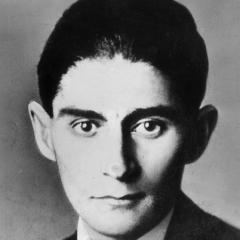
Franz Kafka
Franz Kafka

Franz Kafka (July 3, 1883 - June 3, 1924) was an important German-language novelist of the 20th century, known for his unique literary style and profound philosophical thoughts. His works, often themed around loneliness, alienation, and existentialism, have had a profound impact on literature and philosophy. more

You May Also Like

“When you suffer, you are being conformed to the image of Jesus. When you pray, you are being made holy in the image of Jesus. When you quietly serve a person in need, you are being shaped into the image of Jesus. When you generously give, your heart is being remade into the image of Jesus, our Lord and Savior.”

“P.S.2. During the day, they are drilling us on passwords we will need in the jungle in case we run into a Japanese spy dressed like a USMC. One of them was "Who lost game 4 of the 1941 W. Series?" Half the guys said "Brooklyn" and the other half said "Mickey Owen" and the third half said "Tommy Henrich". Then some fist fights happened so they scrapped the question. But I told you so.”

“Mon dieu! — George Mallory! When that’s been written, what more need be said? My hand trembles, my heart palpitates, my whole being swoons away at the words — oh heavens! heavens! I found of course that he’d been absurdly maligned — he’s six foot high, with the body of an athlete by Praxiteles, and a face — ah, incredible — the mystery of Botticelli, the refinement and delicacy of a Chinese print, the youth and piquancy of an unimaginable English boy . . . . For the rest, he’s going to be a schoolmaster, and his intelligence is not remarkable. What’s the need?”

“Have you been reading the letters of Rosa Luxemburg again, Donatella?’ Brunetti asked in a normal voice. She laughed her bright laugh, a sound he delighted in hearing because to be thought clever or amusing by this woman was, to Brunetti, a jewel of great price. ‘No dear, not recently. Besides, they’re very serious and filled with lofty thoughts about the inner contradictions of capitalism, and I’m too old to enjoy reading things like that.’ She gave him a level glance as though she were testing how far she could go – the same look he had sometimes been given by her daughter – and added, ‘And too rich.’ This time it was Brunetti who laughed.”

“In retrospect it is scarcely believable that insulting letters passing between obscure people in a small town should result in four assize trials and two Court of Criminal Appeal hearings, and claim the time of a distinguished Scotland Yard officer, the Director of Public Prosecutions, and the senior Treasury Counsel.”