Quotessence
Home / Quotes / Quote by Rainbow Rowell

Quote by Rainbow Rowell

“There’s no safe time for me to see you, nothing about you that doesn’t tear my heart from my chest and leave it breakable outside my body.”

Quote by Rainbow Rowell

Author
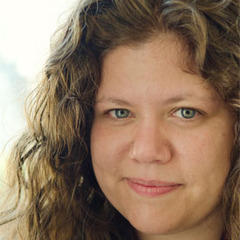
Rainbow Rowell
Rainbow Rowell

Rainbow Rowell (born 1973) is a bestselling American author known for her works in young adult and adult fiction. Her notable novels include 'Eleanor & Park,' 'Fangirl,' and 'Carry On,' which are praised for their emotional depth, relatable characters, and clever integration of pop culture. Rowell's stories often explore themes of adolescence, love, family, and identity, with a warm and humorous writing style. She was born in Omaha, Nebraska, and worked as a newspaper columnist before turning to fiction. Her books have appeared on The New York Times bestseller list and have been translated into multiple languages, earning her a global fanbase. Rowell also writes comics and screenplays, showcasing her versatility as a storyteller. more

You May Also Like

“When facts are treated as if they were opinions, when there is no universal standard by which to determine truth in law, in science, in scholarship, or in the reporting of events of the day, the world becomes a place where lies become true, where people can believe what they want to believe, where there is no possibility of reaching any conclusion not predetermined by those who interpret the official, divinely inspired text.”

“Little gods Heresy: Bishop Earl Paulk (1927-2009) was a founding member of the New Apostolic Reformation. He is the former pastor of the Cathedral of Chapel Hill in Decatur, Georgia (1). He writes in The Wounded Body of Christ, that the Church’s goal is to incarnate Christ so we can bring Him back. He says Jesus was the incarnation of God from the past, but the Church is “the only Christ, the only incarnation of God in the world today (2).” “We are the essence of God, His ongoing incarnation in the world (3).” He says we are little gods, “Just as dogs have puppies and cats have kittens, so God has little gods.” Bishop Paulk states that when God said, “Let us make man in our image,’ he created us as little gods….” He says the Church cannot manifest the Kingdom of God until they start acting like gods (4). Finally, he states “We are ‘little gods,’ whether we admit it or not (5).” References: 1. White, Gail. “Sex Charges cast pall on Bishop Paulk.” Atlanta Constitutional Journal. 08-31-2007. 2. Paulk, Earl. The Wounded Body of Christ. 2nd ed., K Dimension Publishers, 1985, pp. 92-95. 3. Paulk, Earl. Thrust in the Sickle and Reap. K Dimension Publishers, 1986, pp. 132, 70. 4. Paulk, Earl. Satan Unmasked. K Dimension Publishers, 1984, pp. 96-97. 5. Paulk, Earl. Held up in the Heavens Until... God's Strategy for Planet Earth. K Dimension Publishers, 1985, p. 171.”

“Rev. David Wilkerson Warned that Former Witches Have Infiltrated Many Christian Churches: David Wilkerson exposed the current efforts of false teachers to infiltrate Christianity. Rev. Wilkerson was the pastor at Times Square Church in New York City, where he founded Teen Challenge, an addiction recovery program. He wrote, The Cross and the Switchblade, and he served as an evangelist for over 50 years (1). Throughout his ministry, Rev. Wilkerson preached against apostasy, including dominionism and the teaching that there is no literal return of Jesus (2). Shortly before his death, he stated that several former witches warned him that occultists were infiltrating the Church. They said witches are penetrating congregations and masquerading as super-spiritual Christians (3). Today, it is difficult to find a Christian Church that has not been transformed by this occult revival. References: 1. Wilkerson, David. The Cross and the Switchblade. Jove Publications. 1962. 2. Wilkerson, David, Rev. “Witchcraft in the Church.” Believers Web.org, 3. IBID.”

“There is a growing sentiment in America today that animals, too, have rights and that we collectively should afford them, at the very least, more respect and consideration as the sentient, autonomous beings they clearly are. Of course, this flies in the face of Western civilization's stated assumption of man's dominion over the beasts. The way we resolve this conflict in our culture, or fail to, has much to do with who we are, who we will become, and the legacy we leave for generations to come.”

“I didn’t confront the Dominionists directly, instead choosing to minister to the sick and hungry New Orleanians who arrived in DeQuincy in Katrina’s wake. But inside, I fumed at the Dominionist faction at Grace. Katrina was not about God’s judgment; it was about a storm that started as a low-pressure zone that slowly, dangerously grew into a tropical wave of low pressure. Katrina had a natural cause, not a supernatural cause. What flooded New Orleans and sent its citizenry into exile was not, as the Dominionists at Grace argued, God running spiritually corrupt, lost souls out of town but rather a catastrophically flawed levee system constructed by human hands. Besides, I believed that what we did to help those affected by the storm—not why the storm or its destruction happened—was what mattered. My Katrina-era messages were just blandly positive—I preached that the storm was a moment to prove to God just how loving we could be to one another—but the Dominionists at Grace were furious nonetheless. “Are you really saying,” they chided me after Sunday services, “that it doesn’t matter how people in New Orleans live? That they can be saved if they’re alcoholics?” I was unflinching in my answer. “Yes, “ I replied sternly, “that’s exactly what I’m saying.” The Dominionists simply shook their heads in disgust at my apostasy.”