Quotessence
Home / Quotes / Quote by Aleksandr Solzhenitsyn

Quote by Aleksandr Solzhenitsyn

“Wherever they went—Moscow, Tehran, the Syrian coast, Switzerland—a furnished house, villa, or apartment awaited the young couple. And their philosophies of life were the same: "We have only one life!" So take everything life can give, except one thing: the birth of a child. For a child is an idol who sucks dry the juices of your being without any return for your sacrifices, not even ordinary gratitude.”

Quote by Aleksandr Solzhenitsyn

Work

The First Circle

This book is a profound exploration of the human condition, delving into the complexities of life, morality, and the search for meaning. Set in a fictional setting, it follows a group of individuals who are engaged in a quest for self-discovery and understanding. more

Author

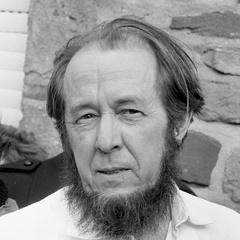
Aleksandr Solzhenitsyn

Aleksandr Solzhenitsyn, a Russian novelist, was born on December 11, 1918, and died on August 3, 2008. He is renowned for his works that profoundly exposed the dark side of the Soviet political system and is considered one of the greatest writers of the 20th century. more

You May Also Like

“Those who floated in the ark were weightless and had weightless thoughts. They were neither hungry nor satisfied. They had no happiness and no fear of losing it. Their heads were not filled with petty official calculations, intrigues, promotions, and their shoulders were not burdened with concerns about housing, fuel, bread, and clothes for the children. Love, which from time immemorial has been the delight and the torment of humanity, was powerless to communicate to them its thrill or its agony. Their prison terms were so long that no one even thought of the time when he would go out into freedom. Men with exceptional Intellect, education, and experience, but too devoted to their families to have much of themselves left over for their friends, here belonged only to friends.”

“The experience of the Allies who vainly tried to locate one self-confessed and convinced Nazi among the German people, 90 per cent of whom probably had been sincere sympathizers at one time or another, is not to be taken simply as a sign of human weakness or gross opportunism. Nazism as an ideology had been so fully “realized” that its content ceased to exist an an independent set of doctrines, lost its intellectual existence, so to speak; destruction of the reality therefore left almost nothing behind, least of all the fanaticism of believers.”

“—and I say you still haven't answered my question, Father Bleu." "Haven't I, dear lady? I thought I stated that death is merely the beginning of—" "No, no, no!" Her voice was as high as a harpy's. "Don't go all gooey and metaphysical. I mean to ask, what is death the act, the situation, the moment?" She watched him foxily. The priest in turn struggled to remain polite. "Madame, I'm not positive I follow." "Let me say it another way. Most people are afraid of dying, yes?" "I disagree. Not those who find mystical union with the body of Christ in—" "Oh, come off it!" Madame Kagle shrilled. "People are frightened of it, Father Bleu. Frightened and screaming their fear silently every hour of every day they live. Now I put it to you. Of what are they afraid? Are they afraid of the end of consciousness? The ultimate blackout, so to speak? Or are they afraid of another aspect of death? The one which they can't begin to foresee or understand?" "What aspect is that, Madame Kagle?" "The pain." She glared. "The pain, Father. Possibly sudden. Possibly horrible. Waiting, always waiting somewhere ahead, at an unguessable junction of time and place. Like that bootboy tonight. How it must have hurt. One blinding instant when his head hit, eh? I suggest, Father Bleu, that is what we're afraid of, that is the wholly unknowable part of dying—the screaming, hurting how, of which the when is only a lesser part. The how is the part we never know. Unless we experience it." She slurped champagne in the silence. She eyed him defiantly. "Well, Father? What have you got to say?" Discreetly Father Bleu coughed into his closed fist. "Theologically, Madame, I find the attempt to separate the mystical act of dying into neat little compartments rather a matter of hairsplitting. And furthermore—" "If that's how you feel," she interrupted, "you're just not thinking it out." "My good woman!" said Father Bleu gently. "Pay attention to me!" Madame Wanda Kagle glared furiously. "I say you pay attention! Because you have never stopped to think about it, have you? If death resembles going to sleep, why, that's an idea your mind can get hold of, isn't it? You may be afraid of it, yes. Afraid of the end of everything. But at least you can get hold of some notion of something of what it's like. Sleep. But can you get hold of anything of what it must feel like to experience the most agonizing of deaths? Your head popping open like that bootboy's tonight, say? A thousand worms of pain inside every part of you for a second long as eternity? Can you grasp that? No, you can't, Father Bleu. And that's what death is at it's worst—the unknown, the possibly harrowing pain ahead." She clamped her lips together smugly. She held out her champagne glass for a refill. A woman in furs clapped a hand over her fashionably green lips and rushed from the group. Though puzzled, Joy was still all eyes and ears. "Even your blessed St. Paul bears me out, Father." The priest glanced up, startled. "What?" "The first letter to the Corinthians, if I remember. The grave has a victory, all right. But it's death that has the sting." In the pause the furnace door behind her eyes opened wide, and hell shone out. "I know what I'm talking about, Father. I've been there." Slowly she closed her fingers, crushing the champagne glass in her hand. Weeping, blood drooling from her palm down her frail veined arms, she had to be carried out. The party broke up at once.”

“Nineteenth-century Russian literature, swooning with compassion for the suffering brother, had created for Nerzhin, and for everyone reading it for the first time, the image of a haloed, silvery-haired People, embodying all wisdom, moral purity, and spiritual grandeur. But that was far away, on bookshelves; it was somewhere else, in the villages and fields at the crossroads of the nineteenth century. The heavens unfolded, the twentieth century came, and those places had long since ceased to exist under Russian skies.”

“Nationalism always preserved this initial intimate loyalty to the government and never quite lost its function of preserving a precarious balance between nation and state on one hand, between the nationals of an atomized society on the other. Native citizens of a nation-state frequently looked down upon naturalized citizens, those who had received their rights by law and not by birth, from the state and not from the nation....”