“If we do not objectify, and feel instinctively and permanently that words are not the things spoken about, then we could not speak abouth such meaningless subjects as the 'beginning' or the 'end' of time. But, if we are semantically disturbed and objectify, then, of course, since objects have a beginning and an end, so also would 'time' have a 'beggining' and an 'end'. In such pathological fancies the universe must have a 'beginning in time' and so must have been made., and all of our old anthropomorphic and objectified mythologies follow, including the older theories of entropy in physics. But, if 'time' is only a human form of representation and not an object, the universe has no 'beginning in time' and no 'end in time'; in other words, the universe is 'time'-less. The moment we realize, feel permanently, and utilize these realizations and feelings that words are not things, then only do we acquire the semantic freedom to use different forms of representation. We can fit better their structure to the facts at hand, become better adjusted to these facts which are not words, and so evaluate properly m.o (multi-ordinal) realities, which evaluation is important for sanity.”
Quote by Alfred Korzybski
Work
This book delves into the principles of non-Aristotelian systems and general semantics, challenging traditional scientific paradigms. It provides a foundational understanding of these concepts, aiming to enhance critical thinking and communication. more
Author
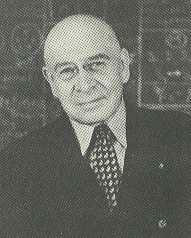
Alfred Korzybski, born on July 3, 1879 in Poland and died on March 1, 1950 in the United States, was a renowned philosopher, writer, and scientist. He is best known for his research on language, thought, and cognition, which had a profound impact on the fields of cognitive science and linguistics. Korzybski's most famous contribution is the 'Korzybski Hypothesis,' which states that human thought is limited by language and symbols. This theory has had a significant influence on the development of cognitive science and linguistics. more
You May Also Like
“The universe is a gathering of nows that I spread before my feet like a landscape.”
“Writing poetry is like having sex with the universe and the language is just a condom.”