Quotessence
Home / Quotes / Quote by Charles Bukowski

Quote by Charles Bukowski

Work

sifting through the madness for the word, the line, the way: New Poems

This volume presents a selection of new poems that delve into the complexities of human experience, offering readers a rich tapestry of imagery and emotion. more

Author
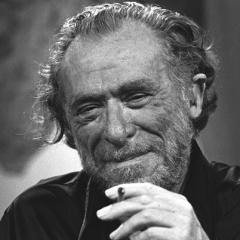
Charles Bukowski
Charles Bukowski

Charles Bukowski, born on August 16, 1920, was an influential American poet. Known for his unique style and profound depiction of the lives of the underclass in America, he is considered one of the representatives of the Beat Generation. more

You May Also Like

“Turn it beautiful. His words came faintly at first, but they came again and again, always softly, always with the insistence of an elder commanding wisdom. Turn it all to beauty. She walked to the rail. When she turned and sat upon it, she heard a sailor in the crowd murmur that she might play them a tune. She hoped he was right. She needed the voices to be wrong. Fin raised the instrument to the cleft of her neck and closed her eyes. She emptied her mind and let herself be carried back to her earliest memory, the first pain she ever knew: the knowledge that her parents didn’t want her. The despair of rejection coursed through her. It fathered a knot of questions that bound her, enveloped her. Waves of uncertainty and frailty shook her to the bones. Her body quivered with anger and hopelessness. She reeled on the edge of a precipice. She wanted to scream or to throw her fists but she held it inside; she struggled to control it. She fought to subjugate her pain, but it grew. It welled up; it filled her mind. When she could hold it no more, exhausted by defiance and wearied by years of pretending not to care, Bartimaeus’s words surrounded her. Got to turn it beautiful. She dropped her defenses. She let weakness fill her. She accepted it. And the abyss yawned. She tottered over the edge and fell. The forces at war within her raced down her arms and set something extraordinary in motion; they became melody and harmony: rapturous, golden. Her fingers coaxed the long-silent fiddle to life. They danced across the strings without hesitation, molding beauty out of the miraculous combination of wood, vibration, and emotion. The music was so bright she felt she could see it. The poisonous voices were outsung. Notes raged out of her in a torrent. She had such music within her that her bones ached with it, the air around her trembled with it, her veins bled it. The men around fell still and silent. Some slipped to the deck and sat enraptured like children before a travelling bard.”

“Some of you may feel that if you don't do something soon to change your life, you will be left by the roadside, alone, homeless and in despair. But is the despair not there as you reach and grapple to create or manifest your desires through your own effort and will? What happens if or when those things appear in your life? Joy? Peace? Or a temporary sense of relief? What if it is relief from the wanting you have been craving for so long, not the outcome, but the relief from the constant wanting.”

“It throbbed and pulsed, channeled by elemental forces of fear, love, hope, and sadness. The bow stabbed and flitted across the strings in a violent whorl of creation; its hairs tore and split until it seemed the last strands would sever in a scrape of dissonance. Those who saw the last fragile remnants held their breath against the breaking. The music rippled across the ship like a spirit, like a thing alive and eldritch and pregnant with mystery. The song held. More than held, it deepened. It groaned. It resounded in the hollows of those who heard. Then it softened into tones long, slow, and patient and reminded men of the faintest stars trembling dimly in defiance of a ravening dark. At the last, when the golden hairs of the bow had given all the sound they knew, the music fled in a whisper. Fin was both emptied and filled, and the song sighed away on the wind.”