Quotessence
Home / Quotes / Quote by Rosa Luxemburg

Quote by Rosa Luxemburg

“It [the proletariat] should and must at once undertake socialist measures in the most energetic, unyielding and unhesitant fashion, in other words, exercise a dictatorship, but a dictatorship of the class, not of a party or of a clique – dictatorship of the class, that means in the broadest possible form on the basis of the most active, unlimited participation of the mass of the people, of unlimited democracy.”

Quote by Rosa Luxemburg

Work

The Russian Revolution

Browse quotes and source details for this work. more

Author
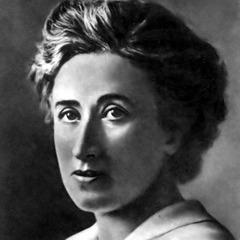
Rosa Luxemburg
Rosa Luxemburg

Rosa Luxemburg (March 5, 1871 – January 15, 1919) was a Polish-German Marxist philosopher, economist, and revolutionary. She was a key figure in the German Social Democratic Party and a co-founder of the Communist Party of Germany. Known for her critique of capitalism, theory of imperialism, and advocacy for socialist democracy, she opposed World War I and was imprisoned for her anti-war activities. Luxemburg was murdered by right-wing paramilitaries during the German Revolution of 1919. Her works, including 'The Accumulation of Capital' and 'The Russian Revolution,' remain influential in Marxist theory. more

You May Also Like

“...the working classes—that motor of social transformation which Marx increasingly stipulated for the role of the proletariat; the dispossessed and alienated revolutionary vehicle of his early writings, which later became defined and analysed into the collective worker who 'owner' nothing but his labour power—chains rather than assets. In the event, the working class actually came to fulfill most of the optimistic prognoses of liberal thinkers; they have become largely 'socialized' through access to privilege, consumption, organization, and voting participation, as well as obtaining massive social benefits. They have become supporters of the status quo—not vociferous perhaps, but tacit approvers and beneficiaries none the less. The ferment today comes from sections of the community to whom political and social thought has never hitherto assigned any specific role; who have hitherto never developed specific political institutions of their own: youth, mostly students; racial minorities, a few dissident intellectuals—these form the new 'proletariat'. The basis of their dissatisfaction is not necessarily and always an objective level of deprivation but rather a mixture of relative deprivation—consciousness of possibilities and of the blockages which prevent their attainment—and above all an articulate dissatisfaction with the society around them. There is no good reason why such groups should not form, and act like, a proletariat in a perfectly Marxist sense. The economic causality collapses; the analysis of a decaying bourgeois society and the determination to overthrow it remain.”

“Theoretically it is, indeed, asserted that the relation between employer and employee is based upon a contract for the accomplishment of a definite purpose. The purpose in this case is social production. But a contract has meaning only when both parties participate equally in the purpose. In reality, however, the worker has today no voice in determining production, for this is given over completely to the employer. The consequence is that the worker is debased by doing a thousand things which constantly serve only to injure the whole community for the advantage of the employer.”

“Every union, every association of persons pursuing identical aims and aspirations, likewise furnishes numerous examples of such higher aims, which pursue not material but only moral rewards. The emulators are moved by the ambition to distinguish themselves, by the desire to serve the common cause. This type of ambition is a virtue, its pursuit promotes the general benefit, while also bringing the individual satisfaction. Ambition is harmful only if it is pursued to the detriment of the community or at the expense of others.”