“Let us consider a sad illumination. The Manhattan office worker moves througha clutter of factory-made, anonymous furniture to a plastic, impersonal kitchen, tobreakfast on canned, packaged anonymous food-fuel; dresses hirself in theanonymous-city-dweller costume, travels through dark tunnels of sooty metal andgray concrete to a dark metal room, foul with polluted air. All day s/he deals withsymbols that have no relevance to hir divine possibilities. This person issurrounded by the dreary, impersonal, assembly-line, mass-produced, anonymousenvironment of an automated robot, which perfectly mirrors hir “turned off’awareness. When this person “turns on,” s/he sees at once the horror of hir surroundings. Ifs/he “tunes in,” s/he begins to change hir movements and hir surroundings sothat they become more in harmony with hir internal beauty. If everyone inManhattan were to “turn on” and “tune in,” grass would grow on First Avenueand tieless, shoeless divinities would dance or roller-skate down the carlessstreets. Ecological consciousness would emerge within 25 years. Fish would swimin a clear-blue Hudson.”
Quote by Timothy Leary
Book:Your Brain Is God
Work
Your Brain Is God
This book delves into the intricate workings of the human brain, drawing parallels between its complexity and the traditional notion of a divine being. It examines various aspects of brain function and consciousness, offering a unique perspective on the nature of human cognition and existence. more
Author
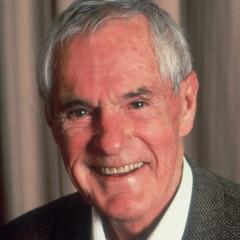
Timothy Leary
Timothy Leary was an American psychologist and philosopher who advocated for the use of psychedelic drugs in psychological research and therapy. He was a leading figure in the 1960s counterculture movement and is known for his slogan 'Turn on, tune in, drop out'. more
You May Also Like
Source: All quiet on the western front
“Hubo un tiempo en que los hombres contaban.”
Source: El final de la cuerda
Source: Cosmos
Source: Persuasion
Source: The Evolution Of Desire: Strategies of Human Mating
“Tuvieron que salir fuera y enfrentarse con los muertos; al menos los hombres lo hicieron”
Source: Aeternum
Source: The Witness
Source: Spinning Silver
Source: Love, Theoretically
Source: Pensé que no existía: EL AMOR