Quotessence
Home / Quotes / Quote by Sappho

Quote by Sappho

“Once again Love, that loosener of limbs, bittersweet and inescapable, crawling thing, seizes me.”

Quote by Sappho

Author
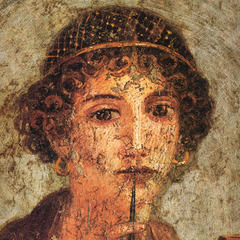
Sappho
Sappho

Sappho, a renowned lyric poet from ancient Greece, lived from 625 BC to 571 BC. She is celebrated for her emotional and lyrical poetry, which has had a profound impact on the history of Greek literature. Sappho's works primarily consist of lyric poems, encompassing themes of love, nature, and philosophy, and she is considered a pioneer of lyric poetry in ancient Greece. more

You May Also Like

“Liberty and Freedom are complex concepts. They go back to religious ideas of Free Will and are related to the Ruler Mystique implicit in absolute monarchs. Without absolute monarchs patterned after the Old Gods and ruling by the grace of a belief in religious indulgence, Liberty and Freedom would never have gained their present meaning. These ideals owe their very existence to past examples of oppression. And the forces that maintain such ideas will erode unless renewed by dramatic teaching or new oppressions. This is the most basic key to my life.”

“But if you write a version of Ragnarok in the twenty-first century, it is haunted by the imagining of a different end of things. We are a species of animal which is bringing about the end of the world we were born into. Not out of evil or malice, or not mainly, but because of a lopsided mixture of extraordinary cleverness, extraordinary greed, extraordinary proliferation of our own kind, and a biologically built-in short-sightedness.”

“Mental discipline, prayer and remoteness from the world and its disturbing visions reduce temptation to a minimum, but they can never entirely abolish it. In medieval traditions, abbeys and convents were always considered to be expugnable centres of revolt against infernal dominion on earth. They became, accordingly, special targets. Satan, issuing orders at nightfall to his foul precurrers, was rumoured to dispatch to capital cities only one junior fiend. This solitary demon, the legend continues, sleeps at his post. There is no work for him; the battle was long ago won. But monasteries, those scattered danger points, become the chief objectives of nocturnal flight; the sky fills with the beat of sable wings as phalanx after phalanx streams to the attack, and the darkness crepitates with the splintering of a myriad lances against the masonry of asceticism.”

“What do you know of the Knights?” he asked. Fin shrugged. “I thought knights were only in children’s stories until a few days ago.” Jeannot smiled. “A man could do worse than to live in the stories of a child. There is, perhaps, no better remembrance.” “Until the child grows up and finds out the stories aren’t true. You might be knights, but I don’t see any shining armor,” Fin said. Jeannot stopped near the gate of the auberge and faced her. “Each time a story is told, the details and accuracies and facts are winnowed away until all that remains is the heart of the tale. If there is truth at the heart of it, a tale may live forever. As a knight, there is no dragon to slay, no maiden to rescue, and no miraculous grail to uncover. A knight seeks the truth beneath these things, seeks the heart. We call this the corso. The path set before us. The race we must run.”

“Wherever the poetry of myth is interpreted as biography, history, or science, it is killed. The living images become only remote facts of a distant time or sky. Furthermore, it is never difficult to demonstrate that as science and history mythology is absurd. When a civilization begins to reinterpret its mythology in this way, the life goes out of it, temples become museums, and the link between the two perspectives is dissolved. Such a blight has certainly descended on the Bible and on a great part of the Christian cult. To bring the images back to life, one has to seek, not interesting applications to modern affairs, but illuminating hints from the inspired past. When these are found, vast areas of half-dead iconography disclose again their permanently human meaning.”