Quotessence
Home / Quotes / Quote by Cornell Woolrich

Quote by Cornell Woolrich

“Lew had never seen a dead man before. He just stood there, and looked and looked. Then he went a step closer, and looked some more. 'So that's what it's like!' he murmured inaudibly. Finally Lew reached out slowly and touched him on the face, and cringed as he met the clammy feel of it, pulled his hand back and whipped it down, as though to get something off it. The flesh was still warm and Lew knew suddenly he had no time alibi. He threw something over that face and that got rid of the awful feeling of being watched by something from the other world. After that Lew wasn't afraid to go near him; he just looked like a bundle of old clothes. The dead man was on his side, and Lew fiddled with the knife-hilt, trying to get it out. It was caught fast, so he let it alone after grabbing it with his fingers from a couple of different directions. Next he went through his pockets, thinking he'd be helping to identify him. The man was Luther Kemp, forty-two, and he lived on 79th Street. But none of that was really true any more, Lew thought, mystified; he'd left it all behind. His clothes and his home and his name and his body and the show he'd paid to see were here. But where the hell had he gone to, anyway? Again that weird feeling came over Lew momentarily, but he brushed it aside. It was just that one of the commonest things in life - death - was still strange to him. But after strangeness comes familiarity, after familiarity, contempt. ("Dusk To Dawn")”

Quote by Cornell Woolrich

Author
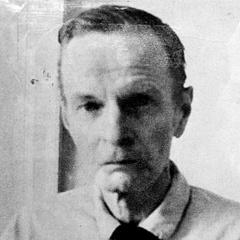
Cornell Woolrich
Cornell Woolrich

Cornell Woolrich was an American novelist known for his suspense novels. His works are characterized by their tense atmosphere and complex psychological descriptions, which have had a profound impact on detective novels and thrillers in films. more

You May Also Like

“In particular those who are condemned to stagnation are often pronounced happy on the pretext that happiness consists in being at rest. This notion we reject, for our perspective is that of existentialist ethics. Every subject plays his part as such specifically through exploits or projects that serve as a mode of transcendence; he achieves liberty only through a continual reaching out towards other liberties. There is no justification for present existence other than its expansion into an indefinitely open future. Every time transcendence falls back into immanence, stagnation, there is a degradation of existence into the ‘en-sois’ – the brutish life of subjection to given conditions – and of liberty into constraint and contingence. This downfall represents a moral fault if the subject consents to it; if it is inflicted upon him, it spells frustration and oppression. In both cases it is an absolute evil. Every individual concerned to justify his existence feels that his existence involves an undefined need to transcend himself, to engage in freely chosen projects.”

“Her body accepted my brutal seed and took it to swell within, just as the patient earth accepts a falling fruit into its tender soil to cradle and nourish it to grow. Came a time, just springtime last, our infant child pushed through the fragile barrier of her womb. Her legs branched out, just as the wood branches out from these eternal trees around us; but she was not hardy as they. My wife groaned with blood and ceased to breathe. Aye!, a scornful eve that bred the kind of pain only a god can withstand.”

“Where have you been?" I asked weakly. A few minutes ago I would have rather died than questioned him. Let him know I care. But I'm too sick to be strong, kick ass Rayne at the moment. "Vegas" he says. I raise an eyebrows. "Uh, okay. Win anything?" I can't believe he was off gambling as I lay dying. I mean, I know poker is hot and all, but couldn't he have waited a couple of days for that straight flush? "I got what I went for, if that's what you mean." "What, a lap dance?" He chuckes. "Even sick, you're still funny, Rayne.”

“I wanted to ask my father about his regrets. I wanted to ask him what was the worst thing he'd ever done. His greatest sin. I wanted to ask him if there was any reason why the Catholic Church would consider him for sainthood. I wanted to open up his dictionary and find the definitions for faith, hope, goodness, sadness, tomato, son, mother, husband, virginity, Jesus, wood, sacrifice, pain, foot, wife, thumb, hand, bread, and sex. "Do you believe in God?" I asked my father. "God has lots of potential," he said. "When you pray," I asked him. "What do you pray about?" "That's none of your business," he said. We laughed. We waited for hours for somebody to help us. What is an Indian? I lifted my father and carried him across every border.”

“Every sign, linguistic or nonlinguistic, spoken or written (in the usual sense of this opposition), as a small or large unity, can be cited, put between quotation marks; thereby it can break with every given context, and engender infinitely new contexts in an absolutely nonsaturable fashion. This does not suppose that the mark is valid outside its context, but on the contrary that there are only contexts without any center of absolute anchoring. This citationality, duplication, or duplicity, this iterability of the mark is not an accident or anomaly, but is that (normal/abnormal) without which a mark could no longer even have a so-called “normal” functioning. What would a mark be that one could not cite? And whose origin could not be lost on the way?”