Quotessence
Home / Quotes / Quote by Julie Powell

Quote by Julie Powell

“Once the leeks and potatoes have simmered for an hour or so, you mash them up with a fork or a food mill or a potato ricer. All three of these options are far more of a pain in the neck than the Cuisinart- one of which space-munching behemoths we scored when we got married- but Julia Child allows as how a Cuisinart will turn soup into "something un-French and monotonous." Any suggestion that uses the construction "un-french" is up for debate, but if you make Potage Parmentier, you will see her point. If you use the ricer, the soup will have bits- green bits and white bits and yellow bits- instead of being utterly smooth. After you've mushed it up, just stir in a couple of hefty chunks of butter, and you're done. JC says sprinkle with parsley but you don't have to. It looks pretty enough as it is, and it smells glorious, which is funny when you think about it. There's not a thing in it but leeks, potatoes, butter, water, pepper, and salt.”

Quote by Julie Powell

Work

Julie & Julia: My Year of Cooking Dangerously

Browse quotes and source details for this work. more

Author
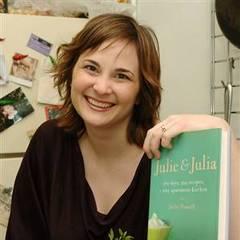
Julie Powell
Julie Powell

Julie Powell, born on April 20, 1973, is an American author. She gained fame with her memoir 'Cooking for Mr. Darcy: A Year of French Cooking,' which chronicles her year-long attempt to cook 500 French recipes from The New York Times. more

You May Also Like

“Rognons de Veau à la Bordelaise is simplicity itself to make; no different, essentially, from Poulet Sauté, and no different, especially, from Bifteck Sauté Bercy. In fact, making it that night felt like falling into a time warp- I stood before the stove, melting butter and browning meat and smelling the smells of wine deglazing and shallots softening- but the dishes changed before my eyes, and I heard Julia warbling, "Boeuf Bourguignon is the same as Coq au Vin. You can use lamb, you can use veal, you can use pork....”

“These days, we've gotten incredibly fussy. With our personal playlists, our complicated made-to-order half-caf, half-decaf lattes, our special mattresses that can adjust for each sleeper, our individually designed college curriculums, we've gotten out of the habit of making do with what's at hand. Part of living with abandon is giving oneself over to one's circumstances without any expectation that things are going to be to our liking anytime soon. We can hope that things will improve, but it shouldn't prevent us from doing what we've set out to do. Julia had an astonishing capacity to be content with what was in front of her, whether it be a cooking school run on spit and a string or a less than perfect hunk of meat. She made do and moved on and rarely regretted it.”

“you calm down and listen carefully to these words.” He pressed the play button on his recorder and held it to the sending end of the telephone.”

“Yet the enslavement of Africans—over 20 percent of the population—served as the linchpin of American democracy; that is, the much-heralded stability and continuity of American democracy was predicated upon black oppression and degradation. Without the presence of black people in America, European-Americans would not be "white"—they would be only Irish, Italians, Poles, Welsh, and others engaged in class, ethnic, and gender struggles over resources and identity. What made America distinctly American for them was not simply the presence of unprecedented opportunities, but the struggle for seizing these opportunities in a new land in which black slavery and racial caste served as the floor upon which white class, ethnic, and gender struggles could be diffused and diverted. In other words, white poverty could be ignored and whites' paranoia of each other could be overlooked primarily owing to the distinctive American feature: the basic racial divide of black and white peoples. From 1776 to 1964… this racial divide would serve as a basic presupposition for the expansive functioning of American democracy, even as the concentration of wealth and power remained in the hands of a Few well-to-do white men.”

“The aim of the High is to remain where they are. The aim of the Middle is to change places with the High. The aim of the Low, when they have an aim—for it is an abiding characteristic of the Low that they are too much crushed by drudgery to be more than intermittently conscious of anything outside their daily lives—is to abolish all distinctions and create a society in which all men shall be equal.”

“It is patent that any group [believing itself to be] surrounded by a world of unbending and irreconcilable foes would see the abyss between itself and them as one that could be spanned by no tie or social obligation. Within such a group, the lie—as told to the "others"—would be neither an act merely tolerated nor a simple rule of social behavior; it would become obligatory and be transformed into a virtue.”

“To those readers who have found the moral strength to overcome the darkness and suffering of the first two volumes, the third volume will disclose a space of freedom and struggle. The secret of this struggle is kept by the Soviet regime even more zealously than that of the torments and annihilation it inflicted upon millions of its victims. More than anything else, the Communist regime fears the revelation of the fight which is conducted against it with a spiritual force unheard of and unknown to many countries in many periods of their history. The fighters' spiritual strength rises to the greatest height and to a supreme degree of tension when their situation is most helpless and the state system most ruthlessly destructive.”