Quotessence
Home / Quotes / Quote by Karl Marx

Quote by Karl Marx

“The bourgeoisie, wherever it has got the upper hand, has put an end to all feudal, patriarchal, idyllic relations. It has pitilessly torn asunder the motley feudal ties that bound man to his 'natural superiors,' and has left remaining no other nexus between man and man than naked self-interest, callous 'cash payment.' It has drowned the most heavenly ecstasies of religious fervor, of chivalrous enthusiasm, of philistine sentimentalism, in the icy water of egotistical calculation. It has resolved personal worth into exchange value, and in place of the numberless indefeasible chartered freedoms, has set up that single, unconscionable freedom—Free Trade. In one word, for exploitation, veiled by religious and political illusions, it has substituted naked, shameless, direct, brutal exploitation. The bourgeoisie has stripped of its halo every occupation hitherto honored and looked up to with reverent awe. It has converted the physician, the lawyer, the priest, the poet, the man of science, into its paid wage laborers. The bourgeoisie has torn away from the family its sentimental veil, and has reduced the family relation to a mere money relation.”

Quote by Karl Marx

Work

The Communist Manifesto

Written by Karl Marx and Friedrich Engels, this influential work analyzes the historical development of capitalism and advocates for the establishment of a classless society through the proletariat's revolution. more

Author
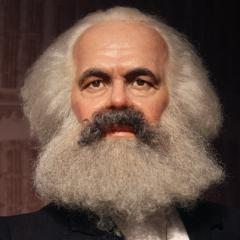
Karl Marx
Karl Marx

Karl Marx (May 5, 1818 - March 14, 1883) was a German philosopher, economist, sociologist, political theorist, and revolutionary. He is one of the founders of Marxism and his works, including 'Das Kapital' and 'The Communist Manifesto', have had a profound impact on the world. more

You May Also Like

“Imperialism was born when the ruling class in capitalist production came up against national limitations to its economic expansion. The bourgeoisie turned to politics out of economic necessity; for if it did not want to give up the capitalist system whose inherent law is constant economic growth, it had to impose this law upon its home governments and to proclaim expansion to be an ultimate political goal of foreign policy.”

“And with this feeling, I poised in my mind some other questions as to the soundness of beliefs I had long held, based upon copy-book maxims drilled into one generation of American children after another: "Merit wins...Survival of the fittest...You can't change human nature...The best people...The poor you have with you always...and the whole long line of rubber-stamp moral precepts. What were these but glittering emblems set up by the moneyed class to serve its own purposes? Born bourgeois, my brain had been filled from infancy with the nonsense of super-patriotism, with the lily-white virtues of imperialism added in due time. I had harbored these false values because I didn't know any better. I had been a drifter, innocent and sheep-minded long enough.”

“The oppressed class, although the ideology of the oppressing class is imposed upon it, nevertheless elaborates religious, ethical and political ideas corresponding to its condition of life; vague and secret at first, they gain in precision and force in proportion as the oppressed class takes definite form and acquires the consciousness of its social utility and of its strength; and the hour of its emancipation is near when its conception of nature and of society opposes itself openly and boldly to that of the ruling class.”

“The militant socialists, following the example of the encyclopedists of the eighteenth century, have to make a merciless criticism of the economic, political, historical, philosophical, moral and religious ideas of the capitalist class in order to prepare in all spheres of thought the triumph of the new ideology which the proletariat introduces into the world.”

“The Marxist critique of the postulates of bourgeois democracy is in fact based on the definition of the class character of modern society. It demonstrates the theoretical inconsistency and the practical deception of a system which pretends to reconcile political equality with the division of society into social classes determined by the nature of the mode of production.”