Quotessence
Home / Quotes / Quote by Edna St. Vincent Millay

Quote by Edna St. Vincent Millay

Work

The Collected Poetry of Edna St. Vincent Millay

This volume includes a selection of Millay's most celebrated works, reflecting her deep emotional insight and poetic prowess, offering readers a glimpse into the beauty and complexity of her verse. more

Author
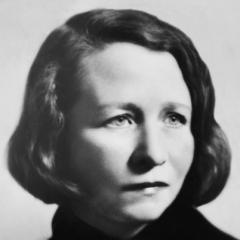
Edna St. Vincent Millay

American poet, known for her lyrical and free verse poetry. Her poems are characterized by their deep portrayal of nature, love, and the female experience. Millay won the Pulitzer Prize for Poetry in 1923, becoming the first woman to receive the award. more

You May Also Like

“When they laid you in the crook of my arms like a bouquet and I looked into your eyes, dark bits of evening sky, I thought, of course this is you, like a person who has never seen the sea can recognize it instantly. They pulled you from me like a cork and all the love flowed out. I adored you with the squandering passion of spring that shoots green from every pore. You dug me out like a well. You lit the deadwood of my heart. You pinned me to the earth with the points of stars. I was sure that kind of love would be enough. I thought I was your mother. How could I have known that over and over you would crack the sky like lightning, illuminating all my fears, my weaknesses, my sins. Massive the burden this flesh must learn to bear, like mules of love.”

“You have layers over layers of a memory in a place. There is the deepest layer, with the ones you love the most, or have the most memories with. Years and years and years. Maybe, you think, I'll make new memories here with new people. Because you can't give up the place entirely-it's physically impossible, or emotionally. And there you are, and both you and the place are layered, like wallpaper on top of wallpaper for centuries, and you'd have to peel everything away, you'd have to be the bare boards, no memories, nothing left. To get rid of some things, you'd have to get rid of everything. So then you are. There you are. Living on. A house with ghosts.”

“(WHEN I WAS A CHILD) I was told that I was insane, seeing doctors in hospitals far away from home. LITTLE WHITE PILLS inside small transparent containers that could fit my baby teeth like seashells, I dreamed. WHEN I WAS A CHILD my mind made up things— not castles of sand, nor careless childish dreams. NOW I AM GROWN I can’t see myself anymore, behind walls of lights I painted on as a child. (BUT NOWADAYS) I cannot think back and wonder if these things ever really happened.”

“We live on the future: "tomorrow," "later on," "when you have made your way," "you will understand when you are old enough"....Yet a day comes when a man notices or says that he is thirty. Thus he asserts his youth. But simultaneously he situates himself in relation to time. He takes his place in it. He admits that he stands at a certain point on a curve that he acknowledges having to travel to its end. He belongs to time, and by the horror that seizes him, he recognizes his worst enemy. Tomorrow, he was longing for tomorrow, whereas everything in him ought to reject it.”