Quotessence
Home / Quotes / Quote by Ludwig von Mises

Quote by Ludwig von Mises

Work

Human action: a treatise on economics

This seminal work delves into the theoretical underpinnings of economics, focusing on the actions and decisions of individuals within a market economy. It is widely regarded as a foundational text in the field of economics, particularly within the Austrian School of thought. more

Author
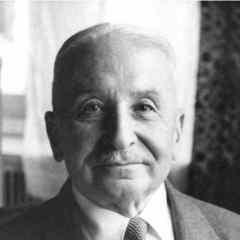
Ludwig von Mises
Ludwig von Mises

Ludwig von Mises was a prominent economist, philosopher, and social theorist born on September 29, 1881, in Austria, and passed away on October 10, 1973. He is considered one of the most influential economists of the 20th century and a leading advocate for free-market economics. more

You May Also Like

“Don't pluck a rose's petals and then ask the rose why it is sad.”

“When I say that evil has to do with killing, I do not mean to restrict myself to corporeal murder. Evil is that which kills spirit. There are various essential attributes of life -- particularly human life -- such as sentience, mobility, awareness, growth, autonomy, will. It is possible to kill or attempt to kill one of these attributes without actually destroying the body. Thus we may "break" a horse or even a child without harming a hair on its head. Erich Fromm was acutely sensitive to this fact when he broadened the definition of necrophilia to include the desire of certain people to control others-to make them controllable, to foster their dependency, to discourage their capacity to think for themselves, to diminish their unpredectibility and originalty, to keep them in line. Distinguishing it from a "biophilic" person, one who appreciates and fosters the variety of life forms and the uniqueness of the individual, he demonstrated a "necrophilic character type," whose aim it is to avoid the inconvenience of life by transforming others into obedient automatons, robbing them of their humanity. Evil then, for the moment, is the force, residing either inside or outside of human beings, that seeks to kill life or liveliness. And goodness is its opposite. Goodness is that which promotes life and liveliness.”

“when all this started, I asked myself, 'Am I going to withdraw from the world, like most people do, or am I going to live?' I decided I'm going to live---or at least try to live---the way I want, with dignity, with courage, with humor, with composure.”

“God created the soul pure, simple and clean of all stain of sin, with a certain beatific instinct towards Himself whence original sin, which the soul finds in itself, draws it away, and when actual is added to original sin the soul is drawn yet further away. The further it departs from its beatific instinct, the more malignant it becomes because it corresponds less to God.”

“It was granted me to carry away from my prison years on my bent back, which nearly broke beneath its load, this essential experience; how a human being becomes evil and how good. In the intoxication of youthful successes I had felt myself to be infallible, and I was therefore cruel. In the surfeit of power I was a murderer, and an oppressor. In my most evil moments I was convinced that I was doing good, and I was well supplied with systematic arguments. And it was only when I lay there on rotting prison straw that I sensed within myself the first stirrings of good. Gradually it was disclosed to me that the line separating good and evil passes not through states, nor between classes, nor between political parties either—but right through every human heart—and through all human hearts. This line shifts. Inside us, it oscillates with the years. And even within hearts overwhelmed by evil, one small bridgehead of good is retained. And even in the best of all hearts, there remains… an unuprooted small corner of evil.”