Quotessence
Home / Quotes / Quote by Walt Whitman

Quote by Walt Whitman

“Song of myself I am of old and young, of the foolish as much as the wise, Regardless of others, ever regardful of others, Maternal as well as paternal, a child as well as a man, Stuff'd with the stuff that is coarse and stuff'd with the stuff that is fine, One of the Nation of many nations, the smallest the same and the largest the same, A Southerner soon as a Northerner, a planter nonchalant and hospitable down by the Oconee I live, A Yankee bound my own way ready for trade, my joints the limberest joints on earth and the sternest joints on earth, A Kentuckian walking the vale of the Elkhorn in my deer-skin leggings, a Louisianian or Georgian, A boatman over lakes or bays or along coasts, a Hoosier, Badger, Buckeye; At home on Kanadian snow-shoes or up in the bush, or with fishermen off Newfoundland, At home in the fleet of ice-boats, sailing with the rest and tacking, At home on the hills of Vermont or in the woods of Maine, or the Texan ranch, Comrade of Californians, comrade of free North-Westerners, (loving their big proportions,) Comrade of raftsmen and coalmen, comrade of all who shake hands and welcome to drink and meat, A learner with the simplest, a teacher of the thoughtfullest, A novice beginning yet experient of myriads of seasons, Of every hue and caste am I, of every rank and religion, A farmer, mechanic, artist, gentleman, sailor, quaker, Prisoner, fancy-man, rowdy, lawyer, physician, priest. I resist any thing better than my own diversity, Breathe the air but leave plenty after me, And am not stuck up, and am in my place.”

Quote by Walt Whitman

Author
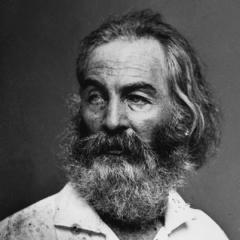
Walt Whitman
Walt Whitman

American poet, considered one of the pioneers of American poetry. His work, 'Leaves of Grass,' has had a profound impact on American poetry. more

You May Also Like

“Now let’s take up the minorities in our civilization, shall we? Bigger the population, the more minorities. Don’t step on the toes of the dog-lovers, the cat-lovers, doctors, lawyers, merchants, chiefs, Mormons, Baptists, Unitarians, second-generation Chinese, Swedes, Italians, Germans, Texans, Brooklynites, Irishmen, people from Oregon or Mexico. The people in this book, this play, this TV serial are not meant to represent any actual painters, cartographers, mechanics anywhere. The bigger your market, Montag, the less you handle controversy, remember that! All the minor minor minorities with their navels to be kept clean. Authors, full of evil thoughts, lock up your typewriters. They did. Magazines became a nice blend of vanilla tapioca. Books, so the damned snobbish critics said, were dishwater. No wonder books stopped selling, the critics said. But the public, knowing what it wanted, spinning happily, let the comic books survive. And the three-dimensional sex magazines, of course. There you have it, Montag. It didn’t come from the Government down. There was no dictum, no declaration, no censorship, to start with, no! Technology, mass exploitation, and minority pressure carried the trick, thank God. Today, thanks to them, you can stay happy all the time, you are allowed to read comics, the good old confessions, or trade journals.”

“If diversity is a source of wonder, its opposite - the ubiquitous condensation to some blandly amorphous and singulary generic modern culture that takes for granted an impoverished environment - is a source of dismay. There is, indeed, a fire burning over the earth, taking with it plants and animals, cultures, languages, ancient skills and visionary wisdom. Quelling this flame, and re-inventing the poetry of diversity is perhaps the most importent challenge of our times.”

“We have got some very big problems confronting us and let us not make any mistake about it, human history in the future is fraught with tragedy ... It's only through people making a stand against that tragedy and being doggedly optimistic that we are going to win through. If you look at the plight of the human race it could well tip you into despair, so you have to be very strong.”

“Our categories are important. We cannot organize a social life, a political movement, or our individual identities and desires without them. The fact that categories invariably leak and can never contain all the relevant "existing things" does not render them useless, only limited. Categories like “woman,” “butch,” “lesbian,” or “transsexual” are all imperfect, historical, temporary, and arbitrary. We use them, and they use us. We use them to construct meaningful lives, and they mold us into historically specific forms of personhood. Instead of fighting for immaculate classifications and impenetrable boundaries, let us strive to maintain a community that understands diversity as a gift, sees anomalies as precious, and treats all basic principles with a hefty dose of skepticism.”

“The American identity has never been a singular one and the voices of poets invariably sing, in addition to their own, the voices of those around them.”

“Along with the mystical wonderment and sense of ecological responsibility that comes with the recognition of connectedness, more disturbing images come to mind. When applied to economics, connectedness seems to take the form of chain stores, multinational corporations, and international trade treaties which wipe out local enterprise and indigenous culture. When I think of it in the realm of religion, I envision smug missionaries who have done such a good job of convincing native people everywhere that their World-Maker is the same as God, and by this shoddy sleight of hand have been steadily impoverishing the world of the great fecundity and complex localism of belief systems that capture truths outside the Western canon. And I wonder—if everything's connected, does that mean that everything can be manipulated and controlled centrally by those who know how to pull strings at strategic places?”