Quotessence
Home / Quotes / Quote by Anthony Boucher

Quote by Anthony Boucher

Work

The Case of the Baker Street Irregulars

Browse quotes and source details for this work. more

Author
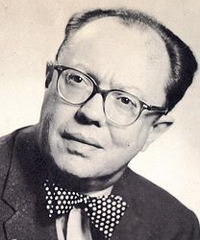
Anthony Boucher
Anthony Boucher

Anthony Boucher, born on August 21, 1911, was an accomplished editor and writer from the United States. Renowned for his contributions to science fiction and crime fiction, he is often hailed as the 'guardian of science fiction'. Boucher's editorial work significantly elevated the quality of many authors' works and propelled the development of science fiction and crime fiction. more

You May Also Like

“We have to condemn publicly the very idea that some people have the right to repress others. In keeping silent about evil, in burying it so deep within us that no sign of it appears on the surface, we are implanting it, and it will rise up a thousandfold in the future. When we neither punish nor reproach evildoers, we are not simply protecting their trivial old age, we are thereby ripping the foundations of justice from beneath new generations. It is for this reason, and not because of the “weakness of indoctrinational work,” that they are growing up “indifferent.” Young people are acquiring the conviction that foul deeds are never punished on earth, that they always bring prosperity. It is going to be uncomfortable, horrible, to live in such a country!”

“Most of us may intuitively agree about right and wrong, but we also, and far more significantly, differ enormously in the ways in which we rank the virtues and the vices. ... To put cruelty first is to disregard the idea of sin as it is understood by revealed religion. Sins are transgressions of a divine rule and offenses against God; pride - the rejection of God - must always be the worst one, which gives rise to all the others. However, cruelty - the willful inflicting of physical pain on a weaker being in order to cause anguish and fear - is a wrong done entirely to another creature. When it is marked as the supreme evil it is judged so in and of itself, and not because it signifies a denial of God or any other higher norm. It is a judgment made from within the world in which cruelty occurs as part of our normal private life and our daily public practices. By putting it unconditionally first, with nothing above us to excuse or to forgive acts of cruelty, one closes off any appeal to any order other than that of actuality. To hate cruelty with utmost intensity is perfectly compatible with Biblical religiosity, but to put it first does place one irrevocably outside the sphere of revealed religion. For it is a purely human verdict upon human conduct, and so puts religion at a certain distance. The decision to put cruelty first is not, however, prompted merely by religious skepticism. It emerges, rather, from the recognition that the habits of the faithful do not differ from those of the faithless in their brutalities, and that Machiavelli had triumphed before he had ever written a line. To put cruelty first therefore is to be at odds not only with religion but with normal politics as well.”

“...all that can, all that need be urged, in the form of expostulation, entreaty, rebuke, against that crime of crimes,--making man the property of his fellow-man! O, how accursed is that system, which entombs the godlike mind of man, defaces the divine image, reduces those who by creation were crowned with glory and honor to a level with four-footed beasts, and exalts the dealer in human flesh above all that is called God! Why should its existence be prolonged one hour? Is it not evil, only evil, and that continually? What does its presence imply but the absence of all fear of God, all regard for man, on the part of the people of the United States? Heaven speed its eternal overthrow!”