Quotessence
Home / Quotes / Quote by Derrick Jensen

Quote by Derrick Jensen

“Even if through simple living and rigorous recycling you stopped your own average Americans annual one ton of garbage production, your per capita share of the industrial waste produced in the US is still almost twenty-six tons. That's thirty-seven times as much waste as you were able to save by eliminating a full 100 percent of your personal waste. Industrialism itself is what has to stop.”

Quote by Derrick Jensen

Work

Deep Green Resistance

Browse quotes and source details for this work. more

Author
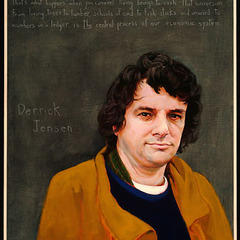
Derrick Jensen
Derrick Jensen

Derrick Jensen is an American author, environmental activist, and speaker. His work primarily focuses on environmental justice, social justice, and the impact of humans on nature. Jensen is known for his radical writing style and critical analysis of environmental destruction. more

You May Also Like

“The eighteenth and nineteenth centuries abandoned the idea of spiritual or intellectual happiness in order to have this material happiness, consisting of a certain number of essential consumer goods. And hence, in the nineteenth century, happiness was linked to a well-being obtained by mechanical means, industrial means, production. The new thing that Saint-Just spoke about was that, in the past, happiness could appear as a very vague, very distant prospect for humanity, whereas now, people seemed to be within reach of the concrete, material possibility of attaining it. That was why happiness was to become an absolutely essential image for the nineteenth-century bourgeoisie, and for modern society. Happiness was attainable thanks to industrial development, and this image of happiness brought us fully into the consumer society.”

“One possibility is just to tag along with the fantasists in government and industry who would have us believe that we can pursue our ideals of affluence, comfort, mobility, and leisure indefinitely. This curious faith is predicated on the notion that we will soon develop unlimited new sources of energy: domestic oil fields, shale oil, gasified coal, nuclear power, solar energy, and so on. This is fantastical cause the basic cause of the energy crisis is not scarcity; it is moral ignorance and weakness of character. We don't know how to use energy, or what to use it for. And we cannot restrain ourselves. Our time is characterized as much by the abuse and waste of human energy as it is by the abuse and waste of fossil fuel energy. Nuclear power, if we are to believe its advocates, is presumably going to be well used by the same mentality that has egregiously devalued and misapplied man- and womanpower. If we had an unlimited supply of solar or wind power, we would use that destructively, too, for the same reasons.”

“Religion has accepted and almost “Christianized” the machine, and it is dying from this, whether through absurdity and hypocrisy, as in the past, or through capitulation and suicide, as today. It is as if there were only two sins, unbelief and unchastity; the machine is neither an unbeliever nor is it unchaste; therefore one may sprinkle it with holy water in good conscience.”

“We're at a crucial point in history. We cannot have fast cars, computers the size of credit cards, and modern conveniences, whilst simultaneously having clean air, abundant rainforests, fresh drinking water and a stable climate. This generation can have one or the other but not both. Humanity must make a choice. Both have an opportunity cost. Gadgetry or nature? Pick the wrong one and the next generations may have neither.”

“From the day when battery-run voices began broadcasting old speeches to battery-run listeners, the beast has been talking to itself. Having swallowed everyone and everything outside itself, the beast becomes its own sole frame of reference. It entertains itself, exploits itself and wars on itself. It has reached the end of its Progress, for there is nothing left for it to progress against except itself.”

“Human communities as variegated in their ways and beliefs as birds are in feathers were invaded, despoiled and at last exterminated beyond imagination’s grasp. The clothes and artifacts of the vanished communities were gathered up as trophies and displayed in museums as additional traces of the march of progress; the extinct beliefs and ways became the curiosities of yet another of the invaders’ many sciences. The expropriated fields, forests and animals were garnered as bonanzas, as preliminary capital, as the precondition for the production process that was to turn the fields into farms, the trees into lumber, the animals into hats, the minerals into munitions, the human survivors into cheap labor. Genocide was, and still is, the precondition, the cornerstone and ground work of the military-industrial complexes, of the processed environments, of the worlds of offices and parking lots.”

“The concerns and methods vary, but there is to it all, at bottom, a message that is unmistakably Luddistic: beware the technological juggernaut, reckon the terrible costs, understand the worlds being lost in the world being gained, reflect on the price of the machine and its systems on your life, pay attention to the natural world and its increasing destruction, resist the seductive catastrophe of industrialism.”