Quotessence
Home / Authors / Derrick Jensen
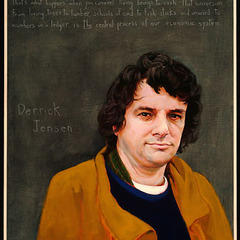
Derrick Jensen

Derrick Jensen Quotes

Author

Filter quotes by topic

Famous Derrick Jensen Quotes

“I am in this same river. I can't much help it. I admit it: I'm racist. The other night I saw a group (or maybe a pack?) or white teenagers standing in a vacant lot, clustered around a 4x4, and I crossed the street to avoid them; had they been black, I probably would have taken another street entirely. And I'm misogynistic. I admit that, too. I'm a shitty cook, and a worse house cleaner, probably in great measure because I've internalized the notion that these are woman's work. Of course, I never admit that's why I don't do them: I always say I just don't much enjoy those activities (which is true enough; and it's true enough also that many women don't enjoy them either), and in any case, I've got better things to do, like write books and teach classes where I feel morally superior to pimps. And naturally I value money over life. Why else would I own a computer with a hard drive put together in Thailand by women dying of job-induced cancer? Why else would I own shirts mad in a sweatshop in Bangladesh, and shoes put together in Mexico? The truth is that, although many of my best friends are people of color (as the cliche goes), and other of my best friends are women, I am part of this river: I benefit from the exploitation of others, and I do not much want to sacrifice this privilege. I am, after all, civilized, and have gained a taste for "comforts and elegancies" which can be gained only through the coercion of slavery. The truth is that like most others who benefit from this deep and broad river, I would probably rather die (and maybe even kill, or better, have someone kill for me) than trade places with the men, women, and children who made my computer, my shirt, my shoes.”

“I saw a stop sign, and it occurred to me that just as no one expects a stop sign to stop a car, I shouldn’t expect words to substitute for experience. That’s not their job, although words certainly can be misused in that way. The job of words is to direct us toward experience, to round out experience, to facilitate experience, and to give us ways to share at least pale shadows of that experience with those we love. And the job of words is to help us learn to be — and act — human.”

“There’s a larger point to be made here than my own obtuseness, which is the fragility, beauty, and at the same time resilience of any communication. An inchoate impulse forms into a feeling that resembles but can never match the dreamy intensity of the original impulse. This feeling then articulates itself, but the words at best approximate a shadow of the feeling. I speak or write these words, and of course the person who receives them brings to that receiving his or her own connotations: Cinnamon, for example, may conjure different memories and may mean something different for you than for me. These words may then settle into feelings, leading finally, perhaps, to some impulse on your part. With so many layers of interpretation, it's no wonder we so often misunderstand each other. And this is between two people who speak the same language. How much more difficult understanding can be, then, when the people do not share a common cultural background, or native tongue? How much more than this may we misunderstand when we then hear a dog speak, or a tree or stone?”

“So while this is a book about fighting back, in the end this is a book about love. The songbirds and the salmon need your heart, no matter how weary, because even a broken heart is still made of love. They need your heart because they are disappearing, slipping into that longest night of extinction, and the resistance is nowhere in sight. We will have to build that resistance from whatever comes to hand: whispers and prayers, history and dreams, from our bravest words and braver actions. It will be hard, there will be a cost, and in too many implacable dawns it will seem impossible. But we will have to do it anyway. So gather your heart and join with every living being. With love as our First Cause, how can we fail?”

“Even if through simple living and rigorous recycling you stopped your own average Americans annual one ton of garbage production, your per capita share of the industrial waste produced in the US is still almost twenty-six tons. That's thirty-seven times as much waste as you were able to save by eliminating a full 100 percent of your personal waste. Industrialism itself is what has to stop.”

“A friend asked, "If increased awareness means less happiness, why bother?" No answer. Three or four nights later I had a dream. I was driving. To my right I saw baby cranes — blue-green, all legs, beak, and wings — standing in a field. They took off and crashed, took off and crashed. I stopped the car and got out. "That looks like it hurts. Why do you do it?" One of the cranes looked me square in the eye. "We may not fly very well yet, but at least we aren't walking." I awoke, happy. From that moment, there has been no turning back.”

“There is a deeper point to be made here, however, having to do with the specificity of everything. One of the great failings of our culture is the nearly universal belief that there can be anything universal. We as a culture take the same approach to living in Phoenix as in Seattle as in Miami, to the detriment of all these landscapes. We turn wild trees to standardized two-by-fours. We turn living fish into fish sticks. But every fish is different from every other fish. Every student is different from every other student. Every place is different from every other place. If we are ever to hope to begin to live sustainably in place (which is the only way to live sustainably), we will have to remember specificity is everything.”

“When people tell me population is the number one environmental problem we face today, I always respond that population is by no means primary. It’s not even secondary or tertiary. First, there’s the question of resource consumption […]. Second is the failure to accept limits, of which overpopulation and overconsumption are merely two linked symptoms.”

“It will be very hard. You’ll make a million mistakes, and you’ll pay for them all, one way or another. But the hard parts will be your parts, they won’t be hard parts other people have imposed on you for their own reasons, or maybe for no reason at all. And your ownership of them – your responsibility to and for them – makes all the difference in the world.”

“I'm reasonably certain, salmon, swordfish, and hammerhead sharks do not find themselves paralyzed by spasms of self-blame for their plight - What could I do differently to placate these people? If only I were a better fish they would not hate me - but instead know precisely who is killing them. The same can be said for the indigenous. You can't get much clearer than Sitting Bull, who said, when forced to speak at a celebration of the completion of a railroad through what had been his people's land: "I hate you. I hate you. I hate all the white people. You are thieves and liars. You have taken away our land and made us outcasts, so I hate you." It's important to note, by the way, that the white translator did not speak these words, but instead the "friendly, courteous speech he had prepared." [Glaspell, Kate Eldridge. "Incidents in the Life of a Pioneer." North Dakota Historical Quarterly, 1941, 187-88.]”

“We are members of the most destructive culture ever to exist. Our assault on the natural world, on indigenous and other cultures, on women, on children, on all of us through the possibility of nuclear suicide and other means--all these are unprecedented in their magnitude and ferocity.”

“A very poor kid came up to me after a talk and said 'I want to go blow up a factory.' I asked how old he was and he said 17. I said 'have you ever had sex?' He said 'no.' I said 'just remember if you get caught you aren't going to have sex for twenty years at least.' That's not saying that one person having sex is worth the salmon. I'm not saying it's a reason not to act, I'm saying don't be stupid.”

“Slavery was a central concern of governance form the time of the first nation-state. The Code of Hammurabi, the earliest know set of laws for governing an empire, prescribed death for anyone who harbored a fugitive or otherwise helped a slave to escape. The relationship between the law and bondage goes back even farther: Indeed, the oldest extant legal documents don't concern the sale of land, houses, or even animals, but slaves.”

“I thought that, given the system of rewards central to our economic system, in which profit maximization is valued above all else and specifically above life, it is probably just as irresistible to the owners of capital (human or otherwise) to exploit workers (and the land): "Nothing personal," they say as they load their property onto the ship bound for the Middle Passage, "but a man's gotta turn a dime."”

“I've since come to understand the reason school lasts thirteen years. It takes that long to sufficiently break a child's will. It is not easy to disconnect children's wills, to disconnect them from their own experiences of the world in preparation for the lives of painful employment they will have to endure.”

“To be clear, civilization is not the same as society. Civilization is a specific, hierarchical organization based on 'power over.' Dismantling civilization, taking down that power structure, does not mean the end of all social order. It should ultimately mean more justice, more local control, more democracy, and more human rights, not less.”

“The pretense that humans are superior to nonhumans is entirely unsupportable. I have seen no compelling evidence that humans are particularly more "intelligent" than any other creature. I have had long and fruitful relationshis with many nonhuman animals, both domesticated and wild, and have reveled in the bouquet of radically different intelligences - different forms, not different "quantities" that they have introduced to me, each in his or her own time, in his or her own way.”

“Civilization is based on a clearly defined and widely accepted yet often unarticulated hierarchy. Violence done by those higher on the hierarchy to those lower is nearly always invisible, that is, unnoticed. When it is noticed, it is fully rationalized. Violence done by those lower on the hierarchy to those higher is unthinkable, and when it does occur is regarded with shock, horror, and the fetishization of the victims.”

“The process of schooling does not give birth to human beings - as education should but never will so long as it springs from the collective consciousness of our culture - but instead it teaches us to value abstract rewards at the expense of our autonomy, curiosity, interior lives, and time.”

“Surely by now there can be few here who still believe the purpose of government is to protect us from the destructive activities of corporations. At last most of us must understand that the opposite is true: that the primary purpose of government is to protect those who run the economy from the outrage of injured citizens.”

“To reverse the effects of civilization would destroy the dreams of a lot of people. There's no way around it. We can talk all we want about sustainability, but there's a sense in which it doesn't matter that these people's dreams are based on, embedded in, intertwined with, and formed by an inherently destructive economic and social system. Their dreams are still their dreams. What right do I -- or does anyone else -- have to destroy them. At the same time, what right do they have to destroy the world?”

“So many indigenous people have said to me that the fundamental difference between Western and indigenous ways of being is that even the most open-minded westerners generally view listening to the natural world as a metaphor, as opposed to the way the world really is. Trees and rocks and rivers really do have things to say to us.”

“If we hope to stem the mass destruction that inevitably attends our economic system (and to alter the sense of entitlement - the sense of contempt, the hatred - on which it is based), fundamental historical, social, economic, and technological forces need to be pondered, understood, and redirected. Behavior won't change much without a fundamental change in consciousness. The question becomes: How do we change consciousness?”

“It's no wonder we don't defend the land where we live. We don't live here. We live in television programs and movies and books and with celebrities and in heaven and by rules and laws and abstractions created by people far away and we live anywhere and everywhere except in our particular bodies on this particular land at this particular moment in these particular circumstances.”