“Surely, the gods' judgment is certain. But as for us, we must be satisfied to 'come close' to those things, for we are men, who speak according to what is likely, and whose lectures resemble fables.”
Quote by Proclus
Author
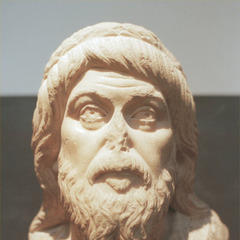
Proclus
Proclus (February 8, 412 – April 17, 485) was a prominent late ancient Greek Neoplatonist philosopher, who served as the head of the Platonic Academy in Athens. He systematized and expanded the teachings of Plotinus and Iamblichus, earning the title 'the culmination of Neoplatonism.' His works cover metaphysics, cosmology, theology, mathematics, and literary criticism. His major writings, including 'Elements of Theology' and 'Platonic Theology,' profoundly influenced medieval Christian, Islamic, and Renaissance thought. Proclus emphasized the 'One' as the ultimate principle, from which all reality emanates through a hierarchy of intellect, soul, and matter. He advocated for a return to the divine through philosophy and mystical rites. His ideas resonated in the works of Pseudo-Dionysius, Thomas Aquinas, and Islamic philosophers, making him a key bridge between ancient and medieval philosophy. more
You May Also Like
Source: From Russia with Love
“...we can endure neither our vices nor the remedies needed to cure them.”
Source: The History of Rome, Books 1-5: The Early History of Rome
Source: Goddesses, Whores, Wives and Slaves: Women in Classical Antiquity
Source: Eyes Of The Scarlet Rose
Source: Valperga
“Go be absolutely, positively, fucking angelic.”
Source: Girl in Pieces