Quotessence
Home / Quotes / Quote by Gertrude Stein

Quote by Gertrude Stein

“Все французы-мужчины знают что нужно стать цивилизованным между восемнадцатью и двадцатью тремя и что цивилизация приходит к вам через отношения с женщинами постарше, через революцию, через военную дисциплину, через побег откуда-нибудь или через подчинение кому-нибудь, после чего вы стали цивилизованным и жизнь идет как надо на латинский лад, жизнь умиротворяющая и интригующая, вот теперь жизнь цивилизованна, логична и модна короче говоря жизнь как жизнь.”

Quote by Gertrude Stein

Work

Paris France

Browse quotes and source details for this work. more

Author

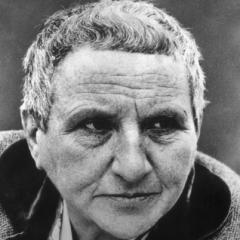
Gertrude Stein
Gertrude Stein

Gertrude Stein, an American writer born on February 3, 1874, and died on July 27, 1946. She is renowned for her unique writing style and her influence on modernist literature. more

You May Also Like

“Thus Milton refines the question down to a matter of faith," said Coleridge, bringing the lecture to a close, "and a kind of faith more independent, autonomous - more truly strong, as a matter of fact - than the Puritans really sought. Faith, he tells us, is not an exotic bloom to be laboriously maintained by the exclusion of most aspects of the day to day world, nor a useful delusion to be supported by sophistries and half-truths like a child's belief in Father Christmas - not, in short, a prudently unregarded adherence to a constructed creed; but rather must be, if anything, a clear-eyed recognition of the patterns and tendencies, to be found in every piece of the world's fabric, which are the lineaments of God. This is why religion can only be advice and clarification, and cannot carry any spurs of enforcement - for only belief and behavior that is independently arrived at, and then chosen, can be praised or blamed. This being the case, it can be seen as a criminal abridgement of a person's rights willfully to keep him in ignorance of any facts - no piece can be judged inadmissible, for the more stones, both bright and dark, that are added to the mosaic, the clearer is our picture of God.”

“Almost immediately, reality gave ground on more than one point. The truth is that it hankered to give ground. Ten years ago, any symmetrical system whatsoever which gave the appearance of order–dialectical materialism, anti-Semitism, Nazism–was enough to fascinate men. Why not fall under the spell of Tlön and submit to the minute and vast evidence of an ordered planet? Useless to reply that reality, too, is ordered. It may be so, but in accordance with divine laws–I translate: inhuman laws–which we will never completely perceive. Tlön may be a labyrinth, but it is a labyrinth plotted by men, a labyrinth destined to be deciphered by men. Contact with Tlön and the ways of Tlön have disintegrated this world. Captivated by its discipline, humanity forgets and goes on forgetting that it is the discipline of chess players, not of angels.”

“জ্বীনদের অস্তিত্ব অবশ্যই আছে। যদি তারা না থাকতো, পবিত্র কোরআনে তাদের প্রসঙ্গ থাকতো না। যুক্তি হচ্ছে- এমন নয় যে জ্বীনদের অস্তিত্ব স্রষ্টা বা পবিত্র কোরআনকে অধিক গৌরবান্বিত করবে। জ্বীনদেরকে সৃষ্টি করলে বা না করলেও স্রষ্টা সদা গৌরবান্বিত। জ্বীন আছে!”

“On the Kantian conception logic as a whole is concerned with investigating the form of the understanding: that is, the form of the intellectual aspect of our overall cognitive faculty to represent objects. Pure general and transcendental logic, in turn, are each concerned with investigating a dimension of that form. On this conception, the source of logical form is not to be comprehended apart from the role of our capacity for thought in the achievement of forms of cognition that are not merely logical. And the source of the notion of mere form of which pure general logic treats is not to be comprehended apart from its internal relation to the full-blooded form of that unified general cognitive capacity - and hence to the forms of the understanding or the categories. This means that on a Kantian understanding of the order of explanatory priority, we must first comprehend the inner logical dimension of form of which transcendental logic treats if we wish to arrive at a proper appreciation of how, via an abstraction, we may arrive at a proper comprehension of the comparatively outer logical dimension of mere form of which pure logical treats - that dimension of form which the rationalist logician, in accordance with his logically thin conception of reason, takes to be self-standingly available.”