Quotessence
Home / Quotes / Quote by Alexander Pope

Quote by Alexander Pope

“Presumptuous Man! the reason wouldst thou find, Why form'd so weak, so little, and so blind? First, if thou canst, the harder reason guess, Why form'd no weaker, blinder, and no less! Ask of thy mother earth, why oaks are made Taller or stronger than the weeds they shade? Or ask of yonder argent fields above, Why Jove's Satellites are less than Jove?”

Quote by Alexander Pope

Work

An Essay on Man

Written by Alexander Pope, this classic work delves into the complexities of human existence, examining moral principles, the purpose of life, and the nature of God. more

Author

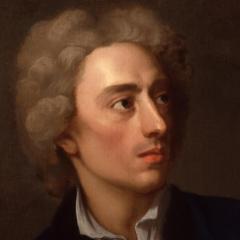
Alexander Pope
Alexander Pope

Alexander Pope, an English poet, was born on May 21, 1688, and died on May 30, 1744. He is renowned for his wit, satire, and elegant poetry, with his most famous works including 'An Essay on Criticism' and 'The Moral Essays'. Pope's works have had a profound impact on literature and philosophy, both in his time and today. more

You May Also Like

“For such is the noble nature of man, that his heart will never wholly lose itself in one single passion or idol, or, as people call it apologetically, one idea. On it goes from one devotion to the next, not because it is ashamed of its first love, but because it must be on fire perpetually. To fall for Reason, as our grandfathers did, is but one Fall of Man among his many passionate attempts to find the apples of knowledge and eternal life, both in one. When a nation, or individual, declines the experiences that present themselves to passionate hearts only, they are automatically turned out from the realm of history. The heart of man either falls in love with somebody or something, or it falls ill. It can never go unoccupied. And the great question for mankind Is what is to be loved or hated next, whenever an old love or fear has lost its hold.”

“God sends his Son – here lies the only remedy. It is not enough to give man a new philosophy or better religion. A Man comes to men. Every man bears an image. His body and his life become visible. A man is not a bare word, a thought or a will. He is above all and always a man, a form, an image, a brother. And thus he does not create around him just a new way of thought, will and action but he gives us the new image, the new form. Now in Jesus Christ this is just what has happened. The image of God has entered our midst, in the form of our fallen life, in the likeness of sinful flesh. In the teaching and acts of Christ, in his life and death, the image of God is revealed. In him the divine image has been re-created here on earth. The Incarnation, the words and acts of Jesus, his death on the cross, all are indispensable parts of that image. But it is not the same image as Adam bore in the primal glory of paradise. Rather, it is the image of one who enters a world of sin and death, who takes upon himself all the sorrows of humanity, who meekly bears God’s wrath and judgment against sinners, and obeys his will with unswerving devotion in suffering and death, the Man born to poverty, the friend of publicans and sinners, the Man of sorrows, rejected of man and forsaken of God. Here is God made man, here is man in the new image of God.”

“A person without a purpose is a human being merely breathing because he does not know where he is, let alone knowing where he is going. Purposelessness is lifelessness.”

“It doubtless seems highly paradoxical to assert that Time is unreal, and that all statements which involve its reality are erroneous. Such an assertion involves a far greater departure from the natural position of mankind than is involved in the assertion of the unreality of Space or of the unreality of Matter. So decisive a breach with that natural position is not to be lightly accepted. And yet in all ages the belief in the unreality of time has proved singularly attractive.”

“All who are not lunatics are agreed about certain things. That it is better to be alive than dead, better to be adequately fed than starved, better to be free than a slave. Many people desire those things only for themselves and their friends; they are quite content that their enemies should suffer. These people can be refuted by science: mankind has become so much one family that we cannot insure our own prosperity except by insuring that of everyone else. If you wish to be happy yourself, you must resign yourself to seeing others also happy.”

“Men wiser and more learned than I have discerned in history a plot, a rhythm, a predetermined pattern. These harmonies are concealed from me. I can see only one emergency following upon another as wave follows upon wave, only one great fact with respect to which, since it is unique, there can be no generalizations; only one safe rule for the historian: that he should recognize in the development of human destinies the play of the contingent and the unforeseen.”