Quotessence
Home / Quotes / Quote by Bertrand Russell

Quote by Bertrand Russell

“All who are not lunatics are agreed about certain things. That it is better to be alive than dead, better to be adequately fed than starved, better to be free than a slave. Many people desire those things only for themselves and their friends; they are quite content that their enemies should suffer. These people can be refuted by science: mankind has become so much one family that we cannot insure our own prosperity except by insuring that of everyone else. If you wish to be happy yourself, you must resign yourself to seeing others also happy.”

Quote by Bertrand Russell

Author
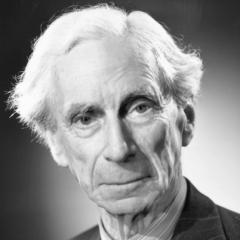
Bertrand Russell
Bertrand Russell

Bertrand Russell was a British philosopher, mathematician, and logician born on May 18, 1872, and died on February 2, 1970. He is known for his contributions to logic and mathematics, particularly in the fields of mathematical logic and philosophical analysis. His works spanned a wide range of subjects, including ethics, political philosophy, history, and literary criticism. more

You May Also Like

“Men wiser and more learned than I have discerned in history a plot, a rhythm, a predetermined pattern. These harmonies are concealed from me. I can see only one emergency following upon another as wave follows upon wave, only one great fact with respect to which, since it is unique, there can be no generalizations; only one safe rule for the historian: that he should recognize in the development of human destinies the play of the contingent and the unforeseen.”

“The supernatural Christ of the New Testament, the god of orthodox Christianity, is dead. But priestcraft lives and conjures up the ghost of this dead god to frighten and enslave the masses of mankind. The name of Christ has caused more persecutions, wars, and miseries than any other name has caused. The darkest wrongs are still inspired by it. The wails of anguish that went up from Kishinev, Odessa, and Bialystok still vibrate in our ears.”

“I am always saddened by the death of a good person. It is from this sadness that a feeling of gratitude emerges. I feel honored to have known them and blessed that their passing serves as a reminder to me that my time on this beautiful earth is limited and that I should seize the opportunity I have to forgive, share, explore, and love. I can think of no greater way to honor the deceased than to live this way.”

“What infinite heart's-ease Must kings neglect, that private men enjoy! And what have kings, that privates have not too, Save ceremony, save general ceremony? And what art thou, thou idle ceremony? What kind of god art thou, that suffer'st more Of mortal griefs than do thy worshippers? What are thy rents? what are thy comings in? O ceremony, show me but thy worth! What is thy soul of adoration? Art thou aught else but place, degree and form, Creating awe and fear in other men? Wherein thou art less happy being fear'd Than they in fearing. What drink'st thou oft, instead of homage sweet, But poison'd flattery? O, be sick, great greatness, And bid thy ceremony give thee cure! Think'st thou the fiery fever will go out With titles blown from adulation? Will it give place to flexure and low bending? Canst thou, when thou command'st the beggar's knee, Command the health of it? No, thou proud dream, That play'st so subtly with a king's repose; I am a king that find thee, and I know 'Tis not the balm, the sceptre and the ball, The sword, the mace, the crown imperial, The intertissued robe of gold and pearl, The farced title running 'fore the king, The throne he sits on, nor the tide of pomp That beats upon the high shore of this world, No, not all these, thrice-gorgeous ceremony, Not all these, laid in bed majestical, Can sleep so soundly as the wretched slave, Who with a body fill'd and vacant mind Gets him to rest, cramm'd with distressful bread; Never sees horrid night, the child of hell, But, like a lackey, from the rise to set Sweats in the eye of Phoebus and all night Sleeps in Elysium; next day after dawn, Doth rise and help Hyperion to his horse, And follows so the ever-running year, With profitable labour, to his grave: And, but for ceremony, such a wretch, Winding up days with toil and nights with sleep, Had the fore-hand and vantage of a king. The slave, a member of the country's peace, Enjoys it; but in gross brain little wots What watch the king keeps to maintain the peace, Whose hours the peasant best advantages.”