Quotessence
Home / Authors / Benjamin Franklin
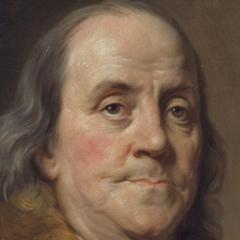
Benjamin Franklin

Benjamin Franklin Quotes

Founding Father of the United States

Filter quotes by topic

Famous Benjamin Franklin Quotes

“My List of Virtues contain'd at first but twelve: But a Quaker Friend having kindly inform'd me that I was generally thought proud; that my Pride show'd itself frequently in Conversation; that I was not content with being in the right when discussing any Point, but was overbearing & rather insolent; of which he convinc'd me by mentioning several Instances; - I determined endeavouring to cure myself ..., and I added Humility to my List, giving an extensive Meaning to the Word.”

“Only a virtuous people are capable of freedom.”

“In reality, there is, perhaps, no one of our natural passions so hard to subdue as pride. Disguise it, struggle with it, beat it down, stifle it, mortify it as much as one pleases, it is still alive, and will every now and then peep out and show itself; you will see it, perhaps, often in this history; for, even if I could conceive that I had completely overcome it, I should probably be proud of my humility.”

“Only a virtuous people are capable of freedom. As nations become corrupt and vicious, they have more need of masters.”

“Be in general virtuous, and you will be happy.”

“I think with you, that nothing is of more importance for the public weal, than to form and train up youth in wisdom and virtue. Wise and good men are in my opinion, the strength of the state; more so than riches or arms.”

“I think vital religion has always suffered when orthodoxy is more regarded than virtue. The scriptures assure me that at the last day we shall not be examined on what we thought but what we did.”

“"We hold these truths to be sacred and undeniable" in a draft of the Declaration of Independence changes it instead into an assertion of rationality. The scientific mind of Franklin drew on the scientific determinism of Isaac Newton and the analytic empiricism of David Hume and Gottfried Leibniz. In what became known as "Hume's Fork" the latters' theory distinguished between synthetic truths that describe matters of fact, and analytic truths that are self-evident by virtue of reason and definition.”

“That there is one God, who made all things. That he governs the world by his providence. That he might be worshipped by adoration, prayer, and thanksgiving. But that the most acceptable service of God is doing good to Man. That the Soul is immortal. And that God will certainly reward virtue and punish vice, either here or hereafter.”

“I think also, that general virtue is more probably to be expected and obtained from the education of youth, than from exhortations of adult persons; bad habits and vices of the mind being, like diseases of the body, more easily prevented than cured. I think moreover, that talents for the education of youth are the gift of God; and that he on whom they are bestowed, whenever a way is opened for use of them, is as strongly called as if he heard a voice from heaven.”

“Whoever feels pain in hearing a good character of his neighbor, will feel a pleasure in the reverse. And those who despair to rise in distinction by their virtues, are happy if others can be depressed to a level of themselves.”

“If a sound body and a sound mind, which is as much as to say health and virtue, are to be preferred before all other considerations, ought not men, in choosing a business either for themselves or children, to refuse such as are unwholesome for the body, and such as make a man too dependent, too much obliged to please others, and too much subjected to their humors in order to be recommended and get a livelihood?”