Quotessence
Home / Authors / Bryan Stevenson
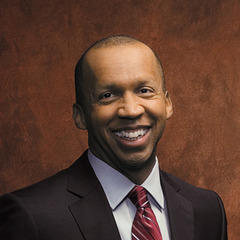
Bryan Stevenson

Bryan Stevenson Quotes

Professor

Filter quotes by topic

Famous Bryan Stevenson Quotes

“I'd grown fond of quoting Václav Havel, the great Czech leader who had said that "hope" was the one thing that people struggling in Eastern Europe needed during the era of Soviet domination. Havel had said that people struggling for independence wanted money and recognition from other countries; they wanted more criticism of the Soviet empire from the West and more diplomatic pressure. But Havel had said that these were things they wanted; the only thing they needed was hope. Not that pie in the sky stuff, not a preference for optimism over pessimism, but rather "an orientation of the spirit." The kind of hope that creates a willingness to position oneself in a hopeless place and be a witness, that allows one to believe in a better future, even in the face of abusive power. That kind of hope makes one strong.”

“The reason why I am hopeful is because what we're now seeing is the formation of a new narrative struggle. When you're enslaved, you have to focus on freedom. When you're being terrorized and lynched, you have to focus on security. When you're disenfranchised and you don't have any opportunities for education and other businesses, you have to focus on civil rights. Now we're at a moment where we are in the beginnings of a narrative struggle. The reason why I'm hopeful is that earlier, even in my career, we didn't have thousands of committed journalists and professionals and storytellers and filmmakers and writers who could participate in this narrative structure. We have never been better situated to win the next phase of this struggle toward a just America than we are right now.”

“But I do think it’s important that we stay hopeful about our capacity to overcome that bigotry. And I am persuaded that hopelessness is the enemy of justice; that if we allow ourselves to become hopeless, we become part of the problem. I think you’re either hopeful, or you’re the problem. There’s no neutral place. Injustice prevails where hopelessness persists. And if I’ve inherited anything from the generation who came before me, I have inherited their wisdom about the necessity of hope.”

“We have a collection of 800 jars of soil in our museum. We collect these soils from lynching sites. People who are involved in erecting markers collect the soil, put it in a jar that has the name of the victim, the date of the victim, and then they bring it back to the museum. An older Black woman was digging soil at a site in west Alabama. She was afraid because it was on a dirt road in the middle of nowhere. As she was about to dig, a big white man in a pickup truck drove by and stared at her. It made her anxious. Then he drove by again and stared some more. Then he parked his truck, got out, and walked toward her. She was terrified. Then the man asked, "What are you doing?" She was going to tell him that she was just getting dirt for her garden. Then she said, "Mr. Stevenson, something got ahold of me. I told that man, I'm digging soil here because this is where a Black man was lynched in 1937." She just looked down and started digging. The man surprised her by asking, "Does that memo you have talk about the lynching?" She said, "It does." Then he asked, "Can I read it?" He started reading while she started digging. After he finished reading the memo, he said, "Would it be all right if I helped you?" She said, "Yes." The man got down on his knees, and she offered him the implement to dig the soil. He said, "No, no, no, no, no, you keep that. I'll just use my hands." She said he started picking up the soil and putting it in the jar, and throwing his hand into the soil. She said there was something about the conviction with which he was putting his whole body into this that moved her. She went from fear to relief to joy so quickly she couldn't help it. Tears were running down her face. The man turned to her and he said, "Oh, ma'am, I'm so sorry I'm upsetting you." She said, "No, no, no. You're blessing me." They kept digging, and they were getting near to filling the jar. She looked over at the man, and she noticed that he had slowed down. His face had turned red. Then she saw that there was a tear running down his face. She reached over and put her hand on his shoulder. She said, "Are you all right?" That's when the man turned her, and he said, "No, ma'am." He said, "I'm just so worried that it might have been my grandfather who helped lynch this man." She said they both sat on that roadside and wept. She said, I'm going to go back and put this jar of soil in the museum in Montgomery. Then the man said, "Ma'am, would it be all right if I just followed you back?" She said, "Sure." She called me on the way back. She said, "Mr. Stevenson, I want you to come to the museum and meet my new friend." I was there when these two people who met on a roadside in a place of pain and agony and violence and bigotry came in and together did something beautiful by putting that jar of soil in that exhibit. I'm not naive. I don't believe that beautiful things like that always happen when we tell the truth. I do believe that we deny ourselves the beauty of justice when we refuse to tell the truth. I've seen too much beauty come out of truth-telling, too much restoration, too much redemption, to believe that truth-telling doesn't have a power that is greater than the fear and anger that is prompting these orders, prompting some of this retreat. I worry about people who are already surrendering and waving white flags, and running for cover. I just don't think that's the way we're going to get to the other side.”

“Havel had said that people struggling for independence wanted money and recognition from other countries; they wanted more criticism of the Soviet empire from the West and more diplomatic pressure. But Havel had said that these were things they wanted; the only thing they needed was hope. Not that pie in the sky stuff, not a preference for optimism over pessimism, but rather 'an orientation of the spirit.' The kind of hope that creates a willingness to position oneself in a hopeless place and be a witness, that allows one to believe in a better future, even in the face of abusive power. That kind of hope makes one strong.”