Quotessence
Home / Authors / Bryan Stevenson
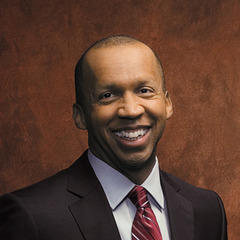
Bryan Stevenson

Bryan Stevenson Quotes

Professor

Filter quotes by topic

Famous Bryan Stevenson Quotes

“...it’s really the broken among us that can contribute a lot to our quest for full, equal justice. I mean, when you’re broken, you actually, you know something about what it means to be human. You know something about grace. You learn something about mercy. You learn something about forgiveness. It’s the broken among us that can teach us some things. And knowing that you don’t have to be perfect and complete gives you a way of moving through challenge that would be hard if you think that that’s not something that’s possible.”

“I told myself that evening what I had been telling my clients for years. I am more than broken. In fact, there is a strength, a power even, in understanding brokenness, because embracing our brokenness creates a need and desire for mercy, and perhaps a corresponding need to show mercy. When you experience mercy, you learn things that are hard to learn otherwise. You see things you can’t otherwise see; you hear things you can’t otherwise hear. You begin to recognize the humanity that resides in each of us.”

“Paul Farmer, the renowned physician who has spent his life trying to cure the world's sickest and poorest people, once quoted me something that the writer Thomas Merton said: We are bodies of broken bones. I guess I'd always known but never fully considered that being broken is what makes us human. We all have our reasons. Sometimes we're fractured by the choices we make; sometimes we're shattered by things we would never have chosen. But our brokenness is also the source of our common humanity, the basis of our shared search for comfort, meaning, and healing. Our shared vulnerability and imperfection nurtures and sustains our capacity for compassion. We have a choice. We can embrace our humanness, which means embracing our broken natures and the compassion that remains our best hope for healing. Or we can deny our brokenness, forswear compassion, and, as a result, deny our own humanity.”

“Paul Farmer, the renowned physician who has spent his life trying to cure the world’s sickest and poorest people, once quoted me something that the writer Thomas Merton said: We are bodies of broken bones. I guess I’d always known but never fully considered that being broken is what makes us human. We all have our reasons. Sometimes we’re fractured by the choices we make; sometimes we’re shattered by things we would never have chosen. But our brokenness is also the source of our common humanity, the basis for our shared search for comfort, meaning, and healing. Our shared vulnerability and imperfection nurtures and sustains our capacity for compassion. We have a choice. We can embrace our humanness, which means embracing our broken natures and the compassion that remains our best hope for healing. Or we can deny our brokenness, forswear compassion, and, as a result, deny our own humanity.”

“We are all broken by something. We have all hurt someone and have been hurt. We all share the condition of brokenness even if our brokenness is not equivalent. I desperately wanted mercy for Jimmy Dill and would have done anything to create justice for him, but I couldn't pretend that his struggle was disconnected from my own. The ways in which I have been hurt—and have hurt others—are different from the ways Jimmy Dill suffered and caused suffering. But our shared brokenness connected us.”

“And I do talk a lot, obviously, about my clients; those are the people I have to advocate for, and when I say that each of us is more than the worst thing we’ve ever done, I am thinking specifically about them. But I’m also thinking about everybody else. I mean, I believe that for every human being. I think if someone tells a lie, they’re not just a liar, that if someone takes something, they’re not just a thief. If you kill someone, you’re not just a killer. But it’s also true, a nation that committed genocide against Indigenous people, a nation that enslaved Black people for two and a half centuries, a nation that tolerated mob lynchings for nearly a century, a nation that created apartheid and segregation laws throughout most of the 20th century, can also be more than that racist history suggests.”

“We are bodies of broken bones. I guess I’d always known but never fully considered that being broken is what makes us human. We all have our reasons. Sometimes we’re fractured by the choices we make; sometimes we’re shattered by things we would never have chosen. But our brokenness is also the source of our common humanity, the basis for our shared search for comfort, meaning, and healing. Our shared vulnerability and imperfection nurtures and sustains our capacity for compassion. We have a choice. We can embrace our humanness, which means embracing our broken natures and the compassion that remains our best hope for healing. Or we can deny our brokenness, forswear compassion, and, as a result, deny our humanity.”

“There is a strength, a power even, in understanding brokenness, because embracing our brokenness creates a need and desire for mercy, and perhaps a corresponding need to show mercy. When you experience mercy, you learn things that are hard to learn otherwise. You see things you can't otherwise see; you hear things you can't otherwise hear. You begin to recognize the humanity that resides in each of us.”