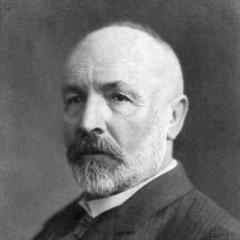
“My theory stands as firm as a rock; every arrow directed against it will return quickly to its archer. How do I know this? Because I have studied it from all sides for many years; because I have examined all objections which have ever been made against the infinite numbers; and above all because I have followed its roots, so to speak, to the first infallible cause of all created things.” KnowsYearsFirstsMadeSpeakCausesSidesNumbersRocksTheoryReturnRootsLogicInfiniteCertaintyUncertaintyFirmReasoningArrowsObjectionsInfallibleOntologyArcher Author:Georg Cantor
“The actual infinite arises in three contexts: first when it is realized in the most complete form, in a fully independent otherworldly being, in Deo, where I call it the Absolute Infinite or simply Absolute; second when it occurs in the contingent, created world; third when the mind grasps it in abstracto as a mathematical magnitude, number or order type.” WorldMindFirstsFormOrderThreeNumbersTypeLogicThirdsAbsolutesInfiniteIndependentAriseCertaintyMathematicalUncertaintyReasoningMagnitudeOntologyFinite Number Author:Georg Cantor
“The old and oft-repeated proposition "Totum est majus sua parte" [the whole is larger than the part] may be applied without proof only in the case of entities that are based upon whole and part; then and only then is it an undeniable consequence of the concepts "totum" and "pars". Unfortunately, however, this "axiom" is used innumerably often without any basis and in neglect of the necessary distinction between "reality" and "quantity", on the one hand, and "number" and "set", on the other, precisely in the sense in which it is generally false.” MayWholeHandsRealityUsedNumbersCasesConceptsConsequenceBasesProofDistinctionNeglectQuantityEntityPropositionsAxioms Author:Georg Cantor
“Every transfinite consistent multiplicity, that is, every transfinite set, must have a definite aleph as its cardinal number.” NumbersConsistentDefiniteCardinalsMultiplicity Author:Georg Cantor
“The transfinite numbers are in a sense the new irrationalities [ ... they] stand or fall with the finite irrational numbers.” FallNumbersMathematicsIrrationalFiniteIrrationalityIrrational Numbers Author:Georg Cantor
“I realize that in this undertaking I place myself in a certain opposition to views widely held concerning the mathematical infinite and to opinions frequently defended on the nature of numbers.” CertainRealizingViewsNumbersOpinionInfiniteMathematicalOppositionUndertakings Author:Georg Cantor
“The transfinite numbers are in a certain sense themselves new irrationalities and in fact in my opinion the best method of defining the finite irrational numbers is wholly disimilar to, and I might even say in priciple the same as, my method described above of introducing trasfinite numbers. One can say unconditionally: the transfinite numbers stand or fall with the finite irrational numbers; they are like each other in their innermost being; for the former like the latter are definite delimited forms or modifications of the actual infinite.” FactsMightFormCertainFallNumbersOpinionDiscoveryInfiniteMethodFormerLatterIntroducingIrrationalDefiniteFiniteDefiningEpiphanyIrrationalityModificationFinite NumberIrrational Numbers Author:Georg Cantor
“What I assert and believe to have demonstrated in this and earlier works is that following the finite there is a transfinite (which one could also call the supra-finite), that is an unbounded ascending lader of definite modes, which by their nature are not finite but infinite, but which just like the finite can be determined by well-defined and distinguishable numbers.” BelieveWellsNumbersDiscoveryInfiniteFollowingDeterminedDefinedDefiniteFiniteEpiphanyAscendingFinite Number Author:Georg Cantor