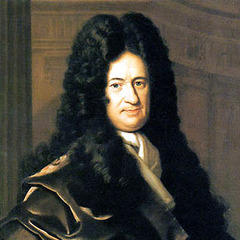
“[Alternate translation:] The Divine Spirit found a sublime outlet in that wonder of analysis, that portent of the ideal world, that amphibian between being and not-being, which we call the imaginary root of negative unity.” WorldScienceSpiritFoundWonderDivineNegativeIdealsRootsUnityAnalysisImaginarySublimeTranslationsOutletsIdeal WorldPortentsAmphibians Author:Gottfried Leibniz
“Music is the pleasure the human mind experiences from counting without being aware that it is counting.” MindHumansSciencePleasureMusicMusic IsMathematicsMathMathematicalHuman MindCountingMath And ScienceMathematics And ScienceNumbers And MathMath LoveMath And LoveMath And Music Author:Gottfried Leibniz
“It is unworthy of excellent men to lose hours like slaves in the labor of calculation which could be relegated to anyone else if machines were used.” IfsMenScienceUsedHoursLosesLaborMachinesSlaveExcellentCalculationsUnworthy Author:Gottfried Leibniz
“These principles have given me a way of explaining naturally the union or rather the mutual agreement [conformité] of the soul and the organic body. The soul follows its own laws, and the body likewise follows its own laws; and they agree with each other in virtue of the pre-established harmony between all substances, since they are all representations of one and the same universe.” WaySoulBodyLawScienceUniverseGivenPrinciplesVirtueHarmonyAgreeUnionsSubstanceAgreementMutualRepresentationExplaining Author:Gottfried Leibniz
“There are also two kinds of truths, those of reasoning and those of fact. Truths of reasoning are necessary and their opposite is impossible, and those of fact are contingent and their opposite is possible. When a truth is necessary its reason can be found by analysis, resolving it into more simple ideas and truths until we reach those which are primitive.” KindTwoIdeasReasonFactsScienceFoundSimpleImpossibleTruth IsOppositesPrimariesAnalysisReasoningSimple Ideas Author:Gottfried Leibniz
“It is God who is the ultimate reason things, and the Knowledge of God is no less the beginning of science than his essence and will are the beginning of things.” ReasonGodScienceEssenceUltimateAccountsKnowledge Of God Author:Gottfried Leibniz
“We should like Nature to go no further; we should like it to be finite, like our mind; but this is to ignore the greatness and majesty of the Author of things.” ShouldMindGodScienceNatureNaturalGreatnessFiniteMajesty Author:Gottfried Leibniz
“It is worth noting that the notation facilitates discovery. This, in a most wonderful way, reduces the mind's labour.” WayMindScienceWonderfulDiscoveryLabourFacilitate Author:Gottfried Leibniz
“Nothing is accomplished all at once, and it is one of my great maxims, and one of the most completely verified, that Nature makes no leaps: a maxim which I have called the law of continuity.” LawScienceNatureNaturalAccomplishedLeapMaximsContinuity Book:New Essays Concerning Human Understanding with an Appealing...: Transtated from the Original Latin, French and German Writeen Source: New Essays Concerning Human Understanding with an Appealing...: Transtated from the Original Latin, French and German Writeen
“Taking mathematics from the beginning of the world to the time when Newton lived, what he had done was much the better half.” WorldDoneScienceTimeHalfMathematicsNewtonBetter Half Author:Gottfried Leibniz
“In symbols one observes an advantage in discovery which is greatest when they express the exact nature of a thing briefly and, as it were, picture it; then indeed the labor of thought is wonderfully diminished.” ScienceNatureDiscoveryAdvantageLaborMathematicsMathPhysicsSymbolsMathematical Author:Gottfried Leibniz
“Our reasonings are grounded upon two great principles, that of contradiction, in virtue of which we judge false that which involves a contradiction, and true that which is opposed or contradictory to the false.” TwoSciencePrinciplesVirtueJudgingReasoningContradictionGroundedContradictory Author:Gottfried Leibniz
“One cannot explain words without making incursions into the sciences themselves, as is evident from dictionaries; and, conversely, one cannot present a science without at the same time defining its terms.” ScienceTermEvidentDefiningDictionary Author:Gottfried Leibniz