Quotessence
Home / Authors / Maimonides
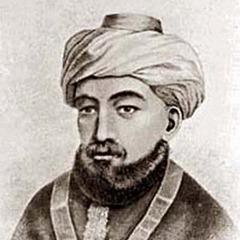
Maimonides

Maimonides Quotes

Philosopher

Filter quotes by topic

Famous Maimonides Quotes

“The Mutakallemim... apply the term non-existence only to absolute non-existence, and not to absence of properties. A property and the absence of that property are considered by them as two opposites, they treat, e.g. , blindness and sight, death and life, in the same way as heat and cold. Therefore they say, without any qualification, non-existence does not require any agent, an agent is required when something is produced.”

“You will see the mercy of God toward His creatures, how He has provided that which is required, in proper proportions, and treated all individual beings of the same species with perfect equality. ...for it is an act of great and perfect goodness that He gave us existence; and the creation of the controlling faculty in animals is a proof of His mercy towards them, as has been shown by us.”

“I find it expressed in various passages of Scripture that the fact that God knows things while in a state of possibility, when their existence belongs to the future, does not change the nature of the possible in any way; that nature remains unchanged; and the knowledge of the realisation of one of several possibilities does not yet effect that realisation. This is likewise one of the fundamental principles of the Law of Moses concerning which there is no doubt nor any dispute.”

“Know that the difficulties which lead to confusion in the question what is the purpose of the Universe or of any of its parts, arise from two causes: first, man has an erroneous idea of himself, and believes that the whole world exists only for his sake; secondly, he is ignorant both about the nature of the sublunary world, and about the Creator's intention to give existence to all beings whose existence is possible, because existence is undoubtedly good.”

“It is not unreasonable to assume that the works of God, their existence and preceding non-existence, are the result of His wisdom, but we are unable to understand many of the ways of His Wisdom in His works. On this principle the whole Law of Moses is based; it begins with this principle: "And God saw all that He had made, and behold, it was very good" (Gen. i. 31); and it ends with this principle: "The Rock, perfect is His work" (Deut. xxxii. 4). Note it.”

“This must be our belief when we have a correct knowledge of our own self, and comprehend the true nature of everything; we must be content, and not trouble our mind with seeking a certain final cause for things that have none, or have no other final cause but their own existence, which depends on the Will of God, or, if you prefer, on the Divine Wisdom.”