Quotessence
Home / Authors / Paul Watzlawick Books
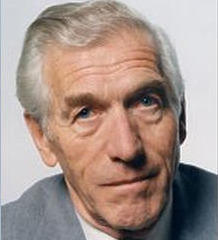
Paul Watzlawick

Paul Watzlawick Books

Psychologist

Related Quotes

“I want to see all oppressed people throughout the world free. And the only way we can do this is by moving toward a revolutionary society where the needs and wishes of all people can be respected.' With these words the radical philosophy professor Angela Davis paraphrases Isaiah's ancient messianic dream of the lion that will peacefully lie down with the lamb in a completely good world. But what the Biblical prophet perhaps could not know is contained with a clarity that leaves nothing to be desired in the opening sentence of an address of the French Senate to Napoleon I: "Sire, the desire for perfection is one of the worst maladies that can affect the human mind.”

“In the irrational universe of demanded spontaneity, the power of state reaches beyond the prohibition of acts contrary to society, assigning itself the task of prescribing the citizen's thoughts and convictions. To quote Revel's concise conclusion, 'C'est dans les sociétiés totalitaires que l'Etat se charge de 'donner un sens' à la vie des êtres' ['In totalitarian societies the state assumes the task of giving life a meaning']. Thus original thought becomes treason, and life becomes a hell of a particular kind.”

“The ideological premise, however, "can" not be defective; it is sacrosanct. ... Whatever does not seem right, whatever does not fit, must be explained by something wrong outside of the ideology; for its perfection is beyond all doubt. In (t)his way the ideology immunizes itself by offering more and more hair-splitting accusations. Betrayal and the dark powers of inner and outer enemies lie in wait everywhere. Theories about conspiracies develop and conveniently hide the absurdity of the premise, necessitating and justifying bloody purges.”

“Karl Popper, in The Open Society and Its Enemies, made a comment that sounds almost prophetic now: that the happy, primitive society (which, by the way, never existed) is lost for all those who have eaten of the fruit of the tree of knowledge. The more we try to return to the heroic age of tribalism, Popper warns, the more certainly we will reach the Inquisition, the secret police, and a romanticized gangsterism. But once the existential problems of the individual, who is good by nature, can be blamed on the "evil" society, nothing stands in the way of sheer imagination. The definition of the benevolent society free of all power is only a question of fantasy.”

“It obviously makes a difference whether we consider ourselves as pawns in a game whose rules we call reality or as players of the game who know that the rules are ‘real’ only to the extent that we have created or accepted them, and that we can change them.”

“As I have already said, the belief that one's own view of reality is the only reality is the most dangerous or all delusions. It becomes still more dangerous if it is coupled with the missionary zeal to enlighten the rest of the world, whether the rest of the world wishes to be enlightened or not. To refuse to embrace wholeheartedly a particular definition of reality, to dare to see the world differently can become a "think crime" in a truly Orwellian sense as we get steadily closer to 1984.”

“Man never ceases to seek knowledge about the objects of his experiences, to understand their meaning for his existence and to react to them according to his understanding. Finally, out of the sum total of the meanings that he has deduced from his contacts with numerous single objects of his environment there grows a unified view of the world into which he finds himself "thrown" (to use an existentialist term again) and this view is of the third order.”

“If we have dwelled on Godel's work at some length, is it because we see it in the mathematical analogy of what we would call the the ultimate paradox of man's existence. Man is ultimately subject and object of his quest. While the question whether the mind can be considered to be anything like a formalized system, as defined in the preceding paragraph, is probably unanswerable, his quest for an understanding of the meaning of his existence is an attempt at formalization.”

“But the solution to the riddle of life and space and time lies outside space and time. For, as it should be abundantly clear by now, nothing inside a frame can state, or even ask, anything about that frame. The solution, then, is not the finding of an answer to the riddle of existence, but the realization that there is no riddle. This is the essence of the beautiful, almost Zen Buddhist closing sentences of the Tracticus: "For an answer which cannot be expressed the question too cannot be expressed. The riddle does not exist."”

“That we do not discover reality but rather invent it is quite shocking for many people. And the shocking part about it - according to the concept of radical constructivism - is that the only thing we can ever know about the real reality (if it even exists) is what it is not. It is only with the collapse of our constructions of reality that we first discover that the world is not the way we imagine.”