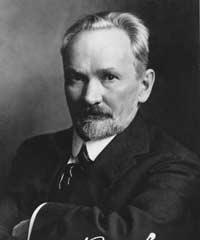
“Thus, Symbolism and Decadence are not a separate new school which arose in France and spread throughout all of Europe: they represent the end and culmination of a certain other school whose links were very extensive and whose roots go back to the beginning of the modern age. Symbolism, easily deduced from Maupassant, can also be deduced from Zola, Flaubert, and Balzac, from Ultra-realism as the antithesis of the previous Ultra-idealism Romanticism and "renascent" Classicism. It is precisely this element of ultra - the result of ultra manifested in life itself, in its mores, ideas, proclivities, and aspirations - that has wormed into literature and remained there ever since, expressing itself, finally, in such a hideous phenomenon as Decadence and Symbolism. The ultra without its referent, exaggeration without the exaggerated object, preciosity of form conjoined with total disappearance of content, and "poetry" devoid of rhyme, meter, and sense - that is what constitutes Decadence.” RealismSymbolismDecadenceBalzacZolaDecadentsSymbolistMaupassantFlaubert Author:Vasily Rozanov
“We observe in this torrent of incoherence a lack of regularity in the subject himself; the "I" has fallen to pieces after struggling for three centuries against the great objective institutions and dissolving them with its subjectivism and rejecting in them any law that was sacred and binding on itself. There is no reason to think that Decadence - obviously an historical phenomenon of great inevitability and significance — has confined itself to poetry; we should expect in the more or less distant future the Decadence of philosophy and finally the Decadence of morality, politics, and forms of communal life. To a certain extent Nietzsche can already be considered the Decadent of human thought — at least to the extent that Maupassant, in certain "final touches" of his art, can be considered the Decadent of human emotion. Like Maupassant, Nietzsche ended in madness; and in Nietzsche, just as in Maupassant, the cult of the "I" loses all restraining limits: the world, history, and the human being with his toils and legitimate demands have disappeared equally from the works of both; both were "mystic males" to a considerable degree, only one of them preferred to "flutter " above "quivering orchids," whereas the other liked to sit inside a cave or upon a mountaintop and proclaim a new religion to mankind in his capacity as the reborn "Zarathustra." The religion of the "superman," he explained. But all of them, including Maupassant, were already "supermen" in that they had absolutely no need of mankind and mankind had absolutely no need of them. On this new type of nisus formativus of human culture, so to speak, we should expect to see great oddities, great hideousness, and perhaps great calamities and dangers. ("On Symbolists And Decadents")” DecadenceNietzscheSubjectivismDecadentsSymbolistMaupassantSymbolists Book:Silver Age of Russian Culture Source: Silver Age of Russian Culture