“In addition to the social pressures from the scientific community there is also at work a very human trait of individual scientist. I call it the law of the instrument , and it may be formulated as follows: Give a small boy a hammer, and he will find that everything he encounters needs pounding. It comes as no particular surprise to discover that a scientist formulates problems in a way which requires for their solution just those techniques in which he himself is especially skilled.”
Quote by Abraham Kaplan
Work
The Conduct of Inquiry: Methodology for Behavioural Science
This book delves into the fundamental methods and techniques used in the study of human behavior, offering insights into the systematic approach to inquiry in the behavioural sciences. more
Author
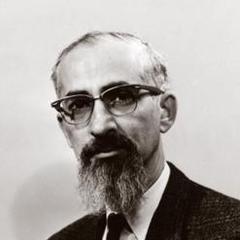
Abraham Kaplan
Abraham Kaplan, an American philosopher, was born on June 11, 1918, and passed away on June 19, 1993. He is known for his contributions to critical theory, phenomenology, and philosophy of language. more
You May Also Like
Source: The Origin of Consciousness in the Breakdown of the Bicameral Mind
“We can only know in the nervous system what we have known in behavior first.”
Source: The Origin of Consciousness in the Breakdown of the Bicameral Mind
Source: The Origin of Consciousness in the Breakdown of the Bicameral Mind
“Indeed, it is sometimes almost as if the problem had to be forgotten to be solved.”
Source: The Origin of Consciousness in the Breakdown of the Bicameral Mind
“It is by metaphor that language grows.”
Source: The Origin of Consciousness in the Breakdown of the Bicameral Mind
Source: The Origin of Consciousness in the Breakdown of the Bicameral Mind
Source: The Origin of Consciousness in the Breakdown of the Bicameral Mind
Source: The Origin of Consciousness in the Breakdown of the Bicameral Mind
Source: The Origin of Consciousness in the Breakdown of the Bicameral Mind