Quotessence
Home / Quotes / Quote by Sigmund Freud

Quote by Sigmund Freud

“The unconscious - that is to say, the 'repressed' - offers no resistance whatever to the efforts of the treatment. Indeed, it itself has no other endeavour than to break through the pressure weighing down on it and force its way either to consciousness or to a discharge through some real action.”

Quote by Sigmund Freud

Work

Beyond the Pleasure Principle

Sigmund Freud's seminal work delves into the nature of human instinct and the pleasure principle, offering insights into the unconscious mind and its influence on human behavior. more

Author
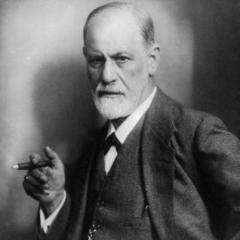
Sigmund Freud
Sigmund Freud

Sigmund Freud, born on May 6, 1856, in Moravia, and died on September 23, 1939, in London, was an Austrian neurologist and the founder of psychoanalysis. Known as the father of modern psychology, Freud made significant contributions to the understanding of human psychology, introducing concepts such as the unconscious mind, dream analysis, and sexual theory. more

You May Also Like

“What psycho-analysis reveals in the transference phenomena of neurotics can also be observed in the lives of some normal people. The impression they give is of being pursued by a malignant fate or possessed by some 'daemonic' power; but psycho-analysis has always taken the view that their fate is for the most part arranged by themselves and determined by early infantile influences.”

“What is a totem? It is as a rule an animal (whether edible and harmless or dangerous and feared) and more rarely a plant or a natural phenomenon (such as rain or water), which stands in a peculiar relation to the whole clan. In the first place, the totem is the common ancestor of the clan; at the same time it is their guardian spirit and helper, which sends them oracles and, if dangerous to others, recognizes and spares its own children.”

“There is scarcely room for doubt that something in the psychological relation of a mother-in-law to a son-in-law breeds hostility between them and makes it hard for them to live together. But the fact that in civilized societies mothers-in-law are such a favourite subject for jokes seems to me to suggest that the emotional relation involved includes sharply contrasted components. I believe, that is, that this relation is in fact an 'ambivalent' one, composed of conflicting affectionate and hostile impulses.”

“Psycho-analysis has taught us that a boy's earliest choice of objects for his love is incestuous and that those objects are forbidden ones - his mother and his sister. We have learnt, too, the manner in which, as he grows up, he liberates himself from this incestuous attraction. A neurotic, on the other hand, invariably exhibits some degree of psychical infantilism. He has either failed to get free from the psychosexual conditions that prevailed in his childhood or he has returned to them - two possibilities which may be summed up as developmental inhibition and regression.”

“Taboo restrictions are distinct from religious or moral prohibitions. They are not based upon any divine ordinance, but may be said to impose themselves on their own account. They differ from moral prohibitions in that they fall into no system that declares quite generally that certain abstinences must be observed and gives reasons for that necessity.”

“Nature delights in making use of the same forms in the most various biological connections: as it does, for instance, in the appearance of branch-like structures both in coral and in plants, and indeed in some forms of crystal and in certain chemical precipitates.”

“Obsessional prohibitions are extremely liable to displacement. They extend from one object to another along whatever paths the context may provide, and this new object then becomes, to use the apt expression of one of my women patients, 'impossible' - till at last the whole world lies under an embargo of 'impossibility'.”