Quotessence
Home / Quotes / Quote by Arthur C. Clarke

Quote by Arthur C. Clarke

“If we have learned one thing from the history of invention and discovery, it is that, in the long run-and often in the short one-the most daring prophecies seem laughably conservative.”

Quote by Arthur C. Clarke

Work

the Promise of Space

This book delves into the concept of space exploration, examining the scientific, technological, and philosophical aspects of expanding human presence beyond Earth. more
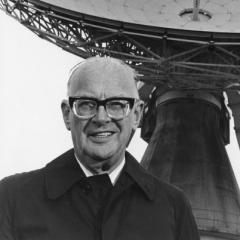
Author

Arthur C. Clarke
Arthur C. Clarke

Arthur C. Clarke was a British science fiction author, writer, and science popularizer. Known for his science fiction novels and predictions about future technology, his most famous works include '2001: A Space Odyssey' and 'Rendezvous with Rama'. Clarke's science fiction novels are not only literarily valuable but also had a profound impact on science fiction films and television. more

You May Also Like

“In that memorable year, 1822: Oersted, a Danish physicist, held in his hands a piece of copper wire, joined by its extremities to the two poles of a Volta pile. On his table was a magnetized needle on its pivot, and he suddenly saw (by chance you will say, but chance only favours the mind which is prepared) the needle move and take up a position quite different from the one assigned to it by terrestrial magnetism. A wire carrying an electric current deviates a magnetized needle from its position. That, gentlemen, was the birth of the modern telegraph.”

“In the history of physics, there have been three great revolutions in thought that first seemed absurd yet proved to be true. The first proposed that the earth, instead of being stationary, was moving around at a great and variable speed in a universe that is much bigger than it appears to our immediate perception. That proposal, I believe, was first made by Aristarchos two millenia ago ... Remarkably enough, the name Aristarchos in Greek means best beginning.”

“In the world's history certain inventions and discoveries occurred, of peculiar value, on account of their great efficiency in facilitating all other inventions and discoveries. Of these were the art of writing and of printing - the discovery of America, and the introduction of Patent-laws. The date of the first ... is unknown; but it certainly was as much as fifteen hundred years before the Christian era; the second-printing-came in 1436, or nearly three thousand years after the first. The others followed more rapidly - the discovery of America in 1492, and the first patent laws in 1624.”

“Indeed, nothing more beautifully simplifying has ever happened in the history of science than the whole series of discoveries culminating about 1914 which finally brought practically universal acceptance to the theory that the material world contains but two fundamental entities, namely, positive and negative electrons, exactly alike in charge, but differing widely in mass, the positive electron-now usually called a proton-being 1850 times heavier than the negative, now usually called simply the electron.”

“It can happen to but few philosophers, and but at distant intervals, to snatch a science, like Dalton, from the chaos of indefinite combination, and binding it in the chains of number, to exalt it to rank amongst the exact. Triumphs like these are necessarily 'few and far between.'”

“It is notorious that the same discovery is frequently made simultaneously and quite independently, by different persons. Thus, to speak of only a few cases in late years, the discoveries of photography, of electric telegraphy, and of the planet Neptune through theoretical calculations, have all their rival claimants. It would seem, that discoveries are usually made when the time is ripe for them - that is to say, when the ideas from which they naturally flow are fermenting in the minds of many men.”

“Just by studying mathematics we can hope to make a guess at the kind of mathematics that will come into the physics of the future... If someone can hit on the right lines along which to make this development, it may lead to a future advance in which people will first discover the equations and then, after examining them, gradually learn how to apply them... My own belief is that this is a more likely line of progress than trying to guess at physical pictures.”