Quotessence
Home / Quotes / Quote by Abraham Maslow

Quote by Abraham Maslow

“The person in peak-experiences feels himself, more than other times, to be the responsible, active, creating center of his activities and of his perceptions. He feels more like a prime-mover, more self-determined (rather than caused, determined, helpless, dependent, passive, weak, bossed). He feels himself to be his own boss, fully responsible, fully volitional, with more "free-will" than at other times, master of his fate, an agent.”

Quote by Abraham Maslow

Work

Toward a Psychology of Being

This book delves into the psychological aspects of human existence, examining the structure of consciousness and the fundamental aspects of human experience. more

Author
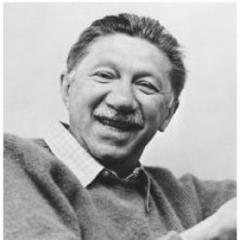
Abraham Maslow
Abraham Maslow

Abraham Maslow was an American psychologist born on April 1, 1908, and died on June 8, 1970. He was a pioneer in humanistic psychology and proposed Maslow's hierarchy of needs, which had a profound impact on the field of psychology. more

You May Also Like

“I just saw an ad the other day that I couldn't believe. There was this woman-and I think it's degrading to womankind-she was going out of her mind over a new product called "A Thousand Flushes." Here she was in her toilet, saying, "Oh, I love this product!" and, "My life is complete!" Good God-if your joy depends on "A Thousand Flushes," you're sick!”

“Many media commercials encourage us to believe that if we buy a certain product, we can be physically appealing, or popular, or successful. According to the commercial message, it may be easy to make friends and influence people if we simply do what we're told to do. It would be wonderful if that were true, but unfortunately life does not seem to work that way. What is inside of us can be much more important and influential than what is outside.”

“All of us somehow felt that the next battleground was going to be culture. We all felt somehow that our culture had been stolen from us-by commercial forces, by advertising agencies, by TV broadcasters. It felt like we were no longer singing our songs and telling stories, and generating our culture from the bottom up, but now we were somehow being spoon-fed this commercial culture top down.”