Quotessence
Home / Quotes / Quote by Erich Fromm

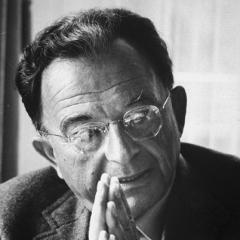
Quote by Erich Fromm

“As with all semantic difficulties, the answer can only be arbitrary. What matters is that we know what kind of union we are talking about when we speak of love. Do we refer to love as the mature answer to the problem of existence, or do we speak of those immature forms of love which may be called symbiotic union?”

Quote by Erich Fromm

Work

THE ART OF LOVING

This book explores the complexities of love, offering insights into its nature, dynamics, and importance in human life. It delves into the psychological and emotional aspects of love, providing readers with tools and strategies to cultivate healthy and fulfilling relationships. more

Author

Erich Fromm
Erich Fromm

Erich Fromm, born on March 23, 1900 in Germany and died on March 18, 1980, was a renowned psychologist. His research covered a wide range of fields including anthropology, philosophy, and religion, particularly known for his studies on human psychology and interpersonal relationships. more

You May Also Like

“and, of course, the self-accursation, the faint heart, the frequent uncertainty and loss of time, which are the nettles and tangling vines in the way of the self-relying and self-directed; and the state of virtual hostility in which he seems to stand to society. For all this loss and scorn, what offset? He is to find consolation in exercising the highest functions of human nature. He is one who raises himself from private considerations and breathes and lives on public and illustrious thoughts. He is the world's eye.”

“Meanwhile, two other great currents in political thought, had a decisive significance on the development of socialist ideas: Liberalism, which had powerfully stimulated advanced minds in the Anglo-Saxon countries, Holland and Spain in particular, and Democracy in the sense. to which Rousseau gave expression in his Social Contract, and which found its most influential representatives in the leaders of French Jacobinism. While Liberalism in its social theories started off from the individual and wished to limit the state's activities to a minimum, Democracy took its stand on an abstract collective concept, Rousseau's general will, which it sought to fix in the national state. Liberalism and Democracy were pre-eminently political concepts, and since most of the original adherents of both did scarcely consider the economic conditions of society, the further development of these conditions could not be practically reconciled with the original principles of Democracy, and still less with those of Liberalism. Democracy with its motto of equality of all citizens before the law, and Liberalism with its right of man over his own person, both were wrecked on the realities of capitalist economy. As long as millions of human beings in every country have to sell their labour to a small minority of owners, and sink into the most wretched misery if they can find no buyers, the so-called equality before the law remains merely a pious fraud, since the laws are made by those who find themselves in possession of the social wealth. But in the same way there can be no talk of a right over one's own person, for that right ends when one is compelled to submit to the economic dictation of another if one does not want to starve.”

“[The] term 'libertarian' itself, to be sure, raises a problem, notably, the specious identification of an anti-authoritarian ideology with a straggling movement for 'pure capitalism' and 'free trade.' This movement never created the word: it appropriated it from the anarchist movement of the [nineteenth] century. And it should be recovered by those anti-authoritarians ... who try to speak for dominated people as a whole, not for personal egotists who identify freedom with entrepreneurship and profit.”

“It was the first time that I had ever been in a town where the working class was in the saddle. Practically every building of any size had been seized by the workers and was draped with red flags and with the red and black flag of the Anarchists; every wall was scrawled with the hammer and sickle and with the initials of the revolutionary parties; almost every church had been gutted and its images burnt. Churches here and there were being systematically demolished by gangs of workmen. Every shop and cafe had an inscription saying that it had been collectivized; even the bootblacks had been collectivized and their boxes painted red and black. Waiters and shop-walkers looked you in the face and treated you as an equal. Servile and even ceremonial forms of speech had temporarily disappeared. Nobody said 'Señor' or 'Don' or even 'Usted'; everyone called everyone else 'Comrade' or 'Thou', and said 'Salud!' instead of 'Buenos días'. Tipping had been forbidden by law since the time of Primo de Rivera; almost my first experience was receiving a lecture from a hotel manager for trying to tip a lift-boy. There were no private motor-cars, they had all been commandeered, and the trams and taxis and much of the other transport were painted red and black. The revolutionary posters were everywhere, flaming from the walls in clean reds and blues that made the few remaining advertisements look like daubs of mud. Down the Ramblas, the wide central artery of the town where crowds of people streamed constantly to and from, the loud-speakers were bellowing revolutionary songs all day and far into the night. And it was the aspect of the crowds that was the queerest thing of all. In outward appearance it was a town in which the wealthy classes had practically ceased to exist. Except for a small number of women and foreigners there were no 'well-dressed' people at all. Practically everyone wore rough working-class clothes, or blue overalls or some variant of militia uniform. All this was queer and moving. There was much in this that I did not understand, in some ways I did not even like it, but I recognized it immediately as a state of affairs worth fighting for...so far as one could judge the people were contented and hopeful. There was no unemployment, and the price of living was still extremely low; you saw very few conspicuously destitute people, and no beggars except the gypsies. Above all, there was a belief in the revolution and the future, a feeling of having suddenly emerged into an era of equality and freedom. Human beings were trying to behave as human beings and not as cogs in the capitalist machine.”

“In fact, I should say to begin with that the term anarchism is quite a range of political ideas, but I would prefer to think of it as the libertarian left, and from that point of view anarchism can be conceived as a kind of voluntary socialism, that is, as libertarian socialist or anarcho-syndicalist or communist anarchist, in the tradition of say Bakunin and Kropotkin and others. They had in mind a highly organized form of society, but a society that was organized on the basis of organic units, organic communities. And generally they meant by that the workplace and the neighborhood, and from those two basic units there could derive through federal arrangements a highly integrated kind of social organization, which might be national or even international in scope. And the decisions could be made over a substantial range, but by delegates who are always part of the organic community from which they come, to which they return and in which, in fact, they live.”

“I am a convinced advocate of economic and social equality because I know that, without it, liberty, justice, human dignity, morality, and the well-being of individuals, as well as the prosperity of nations, will never amount to more than a pack of lies. But since I stand for liberty as the primary condition of mankind, I believe that equality must be established in the world by the spontaneous organization of labor and the collective ownership of property by freely organized producers' associations, and by the equally spontaneous federation of communes, to replace the domineering paternalistic State.”

“By contrast, the traditional revolutionary demand for council forms of organization (what Hannah Arendt describes as "the revolutionary heritage") does not break completely with the terrain of hierarchical society. Workers' councils originate as class councils. Unless one assumes that workers are driven by their interests as workers to revolutionary measures against hierarchical society (an assumption I flatly deny), then these councils can be used just as much to perpetuate class society as to destroy it. We shall see, in fact, that the council form contains many structural limitations which favor the development of hierarchy. For the present, it suffices to say that most advocates of workers' councils tend to conceive of people primarily as economic entities, either as workers or nonworkers. This conception leaves the onesidedness of the self completely intact. Man is viewed as a bifurcated being, the product of a social development that divides man from man and each man from himself. Nor is this one-sided view completely corrected by demands for workers' management of production and the shortening of the work week, for these demands leave the nature of the work process and the quality of the worker's free time completely untouched. If workers' councils and workers' management of production do not transform the work into a joyful activity, free time into a marvelous experience, and the workplace into a community, then they remain merely formal structures, in fact, class structures. They perpetuate the limitations of the proletariat as a product of bourgeois social conditions. Indeed, no movement that raises the demand for workers' councils can be regarded as revolutionary unless it tries to promote sweeping transformations in the environment of the work place.”

“The anarchists cannot consider, like the collectivists, that a remuneration which would be proportionate to the hours of labour spent by each person in the production of riches may be an ideal, or even an approach to an ideal, society. Without entering here into a discussion as to how far the exchange value of each merchandise is really measured now by the amount of labour necessary for its production—a separate study must be devoted to the subject—we must say that the collectivist ideal seems to us merely unrealizable in a society which has been brought to consider the necessaries for production as a common property. Such a society would be compelled to abandon the wage-system altogether. It appears impossible that the mitigated individualism of the collectivist school could co-exist with the partial communism implied by holding land and machinery in common—unless imposed by a powerful government, much more powerful than all those of our own times. The present wage-system has grown up from the appropriation of the necessaries for production by the few; it was a necessary condition for the growth of the present capitalist production; and it cannot outlive it, even if an attempt be made to pay to the worker the full value of his produce, and hours-of-labour-checks be substituted for money. Common possession of the necessaries for production implies the common enjoyment of the fruits of the common production; and we consider that an equitable organization of society can only arise when every wage-system is abandoned, and when everybody, contributing for the common well-being to the full extent of his capacities, shall enjoy also from the common stock of society to the fullest possible extent of his needs.”