Quotessence
Home / Quotes / Quote by Neil deGrasse Tyson

Quote by Neil deGrasse Tyson

“We use the effect of centrifugal forces on matter to offer insight into the rotation rate of extreme cosmic objects. Consider pulsars. With some rotating at upward of a thousand revolutions per second, we know that they cannot be made of household ingredients, or they would spin themselves apart. In fact, if a pulsar rotated any faster, say 4,500 revolutions per second, its equator would be moving at the speed of light, which tells you that this material is unlike any other. To picture a pulsar, imagine the mass of the Sun packed into a ball the size of Manhattan. If that’s hard to do, then maybe it’s easier if you imagine stuffing about a hundred million elephants into a Chapstick casing. To reach this density, you must compress all the empty space that atoms enjoy around their nucleus and among their orbiting electrons. Doing so will crush nearly all (negatively charged) electrons into (positively charged) protons, creating a ball of (neutrally charged) neutrons with a crazy-high surface gravity. Under such conditions, a neutron star’s mountain range needn’t be any taller than the thickness of a sheet of paper for you to exert more energy climbing it than a rock climber on Earth would exert ascending a three-thousand-mile-high cliff. In short, where gravity is high, the high places tend to fall, filling in the low places—a phenomenon that sounds almost biblical, in preparing the way for the Lord: “Every valley shall be raised up, every mountain and hill made low; the rough ground shall become level, the rugged places a plain” (Isaiah 40:4). That’s a recipe for a sphere if there ever was one. For all these reasons, we expect pulsars to be the most perfectly shaped spheres in the universe.”

Quote by Neil deGrasse Tyson

Work

Astrophysics for People in a Hurry

This book provides a succinct and accessible introduction to the fundamental principles of astrophysics, covering topics such as the structure of the universe, black holes, and the nature of dark matter. more

Author
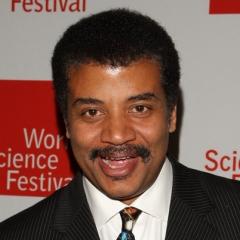
Neil deGrasse Tyson
Neil deGrasse Tyson

Neil deGrasse Tyson is an American astrophysicist, science communicator, and television personality. Born on October 5, 1958, he is renowned for his deep understanding of the cosmos and his ability to popularize scientific knowledge. Tyson grew up in New York City and earned a Ph.D. in astronomy from Columbia University. He served as the director of the Hayden Planetarium at the American Museum of Natural History and has been a member of various scientific committees. more

You May Also Like

“To escape the throngs, we decided to see the new Neil Degrasse Tyson planetarium show, Dark Universe. It costs more than two movie tickets and is less than thirty minutes long, but still I want to go back and see it again, preferably as soon as possible. It was more visually stunning than any Hollywood special effect I’d ever seen, making our smallness as individuals both staggering and - strangely - rather comforting. Only five percent of the universe consists of ordinary matter, Neil tells us. That includes all matter - you, and me, and the body of Michael Brown, and Mork’s rainbow suspenders, and the letters I wrote all summer, and the air conditioner I put out on the curb on Christmas Day because I was tired of looking at it and being reminded of the person who had installed it, and my sad dying computer that sounds like a swarm of bees when it gets too hot, and the fields of Point Reyes, and this year’s blossoms which are dust now, and the drafts of my book, and Israeli tanks, and the untaxed cigarettes that Eric Garner sold, and my father’s ill-fitting leg brace that did not accomplish what he’d hoped for in terms of restoring mobility, and the Denver airport, and haunting sperm whales that sleep vertically, and the water they sleep in, and Mars and Jupiter and all of the stars we see and all of the ones we don’t. That’s all regular matter, just five percent. A quarter is “dark matter,” which is invisible and detectable only by gravitational pull, and a whopping 70 percent of the universe is made up of “dark energy,” described as a cosmic antigravity, as yet totally unknowable. It’s basically all mystery out there - all of it, with just this one sliver of knowable, livable, finite light and life. And did I mention the effects were really cool? After seeing something like that it’s hard to stay mad at anyone, even yourself.”

“Remember how much it upset people when we were told that Pluto wasn't a planet anymore? I'm still mad about that. The only thing I knew for sure about space was "the order of all the planets" (My Very Educated Mother Just Served Us Nine Pizzas), and then that one bit of knowledge was ripped away from me. What mnemonic do kids even use now? I'm aware there are reasons Pluto was demoted, but in my heart, I do not care what Neil deGrasse Tyson says. (Even though I know in my mind he's right, in my heart, I feel he's wrong.)”

“America may be losing a competitive edge in many enterprises, from cars to space, riffed National Public Radio host Scott Simon in the summer of 2010, "but as long as we can devise a five-bladed, mineral-oil-saturated razor, we face the future well-shaved.”

“The chances of any individual animal leaving behind fossilised remains are infinitesimal. First, its dead body has to lie in a place where sediment accumulates. That is most commonly in a lake or sea. Bones lying on the surface of the land are much more likely to be destroyed than preserved. Next, the sediment has to cover the bones before they disappear, preferably even before they are disarticulated. After that, the mud-and the bones within it- has to be compressed and turned into stone by the great, infinitely slow, movements that distort and crumple the earth's crust. That has to happen without the total obliteration of any sign of the bones. And finally, those bones have to be located in the tiny proportion of rocks which happen to be sufficiently close to the surface for them to be discovered by a prospecting palaeontologist. Thus not only have the vast majority of individual animals disappeared without a trace but great numbers of species and families have doubtless existed of which we have no knowledge whatsoever.”

“Not long after coming to Detroit, I heard of a museum of machinery in Dearborn which had been set up by Henry Ford but which, at that time, had not acquired its present popularity. The well-to-do people of fashionable Grosse Pointe and the Detroit workers as well ignored Greenfield Village, as this museum area was called. Almost nobody had any use for it, and I found out about it only through hearing people laugh at "old man Ford" for "wasting" millions on his "pile of scrap iron." These gibes excited my curiosity, and I asked my friends how I could arrange a visit and what was the earliest time I might go. "Any time you like," they answered, not troubling to conceal their disdain.”

“The first thing I encountered on entering the museum was the earliest steam engine built in England. As I walked on, marveling at each successive mechanical wonder, I realized that I was witnessing the history of machinery, as if on parade, from its primitive beginnings to the present day, in all its complex and astounding elaborations. Henry Ford's so-called "pile of scrap iron" was organized not only with scientific clarity but with impeccable, unpretentious good taste. Relics of the times associated with each machine were displayed beside it. To me, Greenfield Village, inside and out, was a visual feast.”

“2002 yılı civarında doğanlar AKP Hükümetinin gölgesinde büyüdüler, oy kullanma yaşına girenlerin hafızasında da kıyaslama yapabilecekleri başka bir siyasi iktidar yok. İlk gençlik dönemine adım atmış bir kuşağın duygularından davranışlarına, beğenilerinden zevklerine kadar her şey, ekseninde AKP’nin olduğu bir kültür dünyasında şekillenmiş sayılır. Çizgileri şimdi bir hayli netleşmiş kültür dünyasının geçmişteki ipuçlarını ve eğer herhangi bir kırılma yaşanmazsa yakın gelecekteki muhtemel evrimini içeren bir tablo çizmek için yeterince uzun bir süre bu. Toplumsal bir dönüşüm yaratmak iddiasıyla iktidara gelen AKP açısından kültür bir derlenip toparlanma, saflaşma aracı olduğu kadar kendisini geçmişe ve muhaliflerine karşı korunaklı kılan, muhalifleri ile yandaşları arasında sınır çizen bir kimlik vurgusuydu. Bu yüzden etrafında saflaştırdığı kesimlerin canını acıtacak iktisadi düzenlemeleri yaparken de, politik kararları alırken de dikkati hep partinin kültürel iddialarında toplamaya çalıştı. Bunda da bir hayli başarılı olduğu söylenebilir. Elinizdeki kitap AKP’nin kurduğu kültür dünyasının artık tamamlanmış resmindeki öğeleri, bunların arasındaki bağıntıları irdelemeye ve denk düştükleri iktisadi ve sosyal ilişkileri tartışmaya çalışıyor. Dizginsiz bir piyasaya Neo-Osmanlıcı ütopyanın tuğrasının basıldığı böyle bir dönemde yoksulun takvasının İslami burjuvazinin marka hırsıyla imtihanından çıkan sonuç AKP döneminin de temel çelişkisi olarak beliriyor. Yeni Türkiye bu ikisi arasındaki kurgulanmış uyumdan değil gizlenemeyen derin çelişkiden doğacak gibi görünüyor.”