Quotessence
Home / Quotes / Quote by Eratosthenes

Quote by Eratosthenes

“Eratosthenes declares that it is no longer necessary to inquire as to the cause of the overflow of the Nile, since we know definitely that men have come to the sources of the Nile and have observed the rains there.”

Quote by Eratosthenes

Author
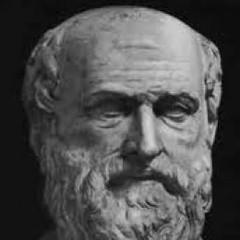
Eratosthenes
Eratosthenes

Eratosthenes (276 BC - 194 BC) was a Greek mathematician, astronomer, and geographer. He is considered one of the greatest mathematicians of ancient Greece and is best known for his method of measuring the size of the Earth. more

You May Also Like

“It is not therefore the business of philosophy, in our present situation in the universe, to attempt to take in at once, in one view, the whole scheme of nature; but to extend, with great care and circumspection, our knowledge, by just steps, from sensible things, as far as our observations or reasonings from them will carry us, in our enquiries concerning either the greater motions and operations of nature, or her more subtile and hidden works. In this way Sir Isaac Newton proceeded in his discoveries.”

“Whether we like it or not, quantification in history is here to stay for reasons which the quantifiers themselves might not actively approve. We are becoming a numerate society: almost instinctively there seems now to be a greater degree of truth in evidence expressed numerically than in any literary evidence, no matter how shaky the statistical evidence, or acute the observing eye.”

“Wherefore also these Kinds [elements] occupied different places even before the universe was organised and generated out of them. Before that time, in truth, all these were in a state devoid of reason or measure, but when the work of setting in order this Universe was being undertaken, fire and water and earth and air, although possessing some traces of their known nature, were yet disposed as everything is likely to be in the absence of God; and inasmuch as this was then their natural condition, God began by first marking them out into shapes by means of forms and numbers.”

“Civility means a great deal more than just being nice to one another. It is complex and encompasses learning how to connect successfully and live well with others, developing thoughtfulness, and fostering effective self-expression and communication. Civility includes courtesy, politeness, mutual respect, fairness, good manners, as well as a matter of good health. Taking an active interest in the well-being of our community and concern for the health of our society is also involved in civility.”