Quotessence
Home / Quotes / Quote by Hippocrates

Quote by Hippocrates

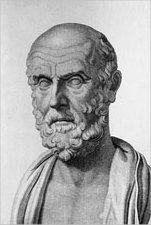
“Any man who is intelligent must, on considering that health is of the utmost value to human beings, have the personal understanding necessary to help himself in diseases, and be able to understand and to judge what physicians say and what they administer to his body, being versed in each of these matters to a degree reasonable for a layman.”

Quote by Hippocrates

Work

Hippocrates

Hippocrates is a collection of medical texts that have had a profound impact on the field of medicine. It is traditionally attributed to the ancient Greek physician Hippocrates, although the actual authorship is uncertain. The work includes a variety of medical theories and practices, many of which have influenced subsequent medical thought and practice. more

Author

Hippocrates
Hippocrates

Hippocrates, a renowned Greek physician, is known as the 'Father of Medicine'. Born in 460 BC and died in 370 BC, he proposed the 'humoral theory' and emphasized the importance of the 'Hippocratic Oath' for doctors. His medical theories and practices have had a profound impact on the world. more

You May Also Like

“Disease is an abnormal state of the body which primarily and independently produces a disturbance in the normal functions of the body. It may be an abnormality of temperament or form (structure). Symptom is a manifestation of some abnormal state in the body. It may be harmful as a colic pain or harmless as the flushing of cheeks in peripneumonia.”

“Go into a room where the shutters are always shut (in a sick-room or a bed-room there should never be shutters shut), and though the room be uninhabited-though the air has never been polluted by the breathing of human beings, you will observe a close, musty smell of corrupt air-of air unpurified by the effect of the sun's rays.”

“If you confine yourself to this Skinnerian technique, you study nothing but the learning apparatus and you leave out everything that is different in octopi, crustaceans, insects and vertebrates. In other words, you leave out everything that makes a pigeon a pigeon, a rat a rat, a man a man, and, above all, a healthy man healthy and a sick man sick.”