Quotessence
Home / Quotes / Quote by Arthur C. Clarke

Quote by Arthur C. Clarke

Work

Profiles Of The Future

This book delves into a wide array of subjects, examining how they might evolve over time and the implications of these changes on society and technology. more

Author
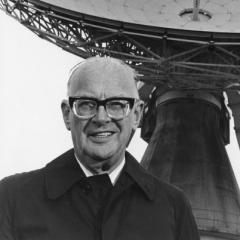
Arthur C. Clarke
Arthur C. Clarke

Arthur C. Clarke was a British science fiction author, writer, and science popularizer. Known for his science fiction novels and predictions about future technology, his most famous works include '2001: A Space Odyssey' and 'Rendezvous with Rama'. Clarke's science fiction novels are not only literarily valuable but also had a profound impact on science fiction films and television. more

You May Also Like

“But in practical affairs, particularly in politics, men are needed who combine human experience and interest in human relations with a knowledge of science and technology. Moreover, they must be men of action and not contemplation. I have the impression that no method of education can produce people with all the qualities required. I am haunted by the idea that this break in human civilization, caused by the discovery of the scientific method, may be irreparable.”

“If there is a regulation that says you have to do something-whether it be putting in seat belts, catalytic converters, clean air for coal plants, clean water-the first tack that the lawyers use, among others things, and that companies use, is that it's going to drive the electricity bill up, drive the cost of cars up, drive everything up. It repeatedly has been demonstrated that once the engineers start thinking about it, it's actually far less than the original estimates. We should remember that when we hear this again, because you will hear it again.”

“In 1891, during the Presidency of William Henry Harrison [Benjamin Harrison], electric lights were first installed in the White House, the residence of the leaders of our country. At that time, commercial electricity was not economically feasible, but President Harrison wanted to affirm his confidence in the technological capability of our country.”

“The most revolutionary aspect of technology is its mobility. Anybody can learn it. It jumps easily over barriers of race and language. ... The new technology of microchips and computer software is learned much faster than the old technology of coal and iron. It took three generations of misery for the older industrial countries to master the technology of coal and iron. The new industrial countries of East Asia, South Korea, and Singapore and Taiwan, mastered the new technology and made the jump from poverty to wealth in a single generation.”

“The oil industry is a stunning example of how science, technology, and mass production can divert an entire group of companies from their main task. ... No oil company gets as excited about the customers in its own backyard as about the oil in the Sahara Desert. ... But the truth is, it seems to me, that the industry begins with the needs of the customer for its products. From that primal position its definition moves steadily back stream to areas of progressively lesser importance until it finally comes to rest at the search for oil.”

“The world has changed far more in the past 100 years than in any other century in history. The reason is not political or economic but technological-technologies that flowed directly from advances in basic science. Clearly, no scientist better represents those advances than Albert Einstein: TIME's Person of the Century.”

“We cannot idealize technology. Technology is only and always the reflection of our own imagination, and its uses must be conditioned by our own values. Technology can help cure diseases, but we can prevent a lot of diseases by old-fashioned changes in behavior.”