Quotessence
Home / Quotes / Quote by Benoit Mandelbrot

Quote by Benoit Mandelbrot

“Round about the accredited and orderly facts of every science there ever floats a sort of dustcloud of exceptional observations, of occurrences minute and irregular and seldom met with, which it always proves more easy to ignore than to attend to.”

Quote by Benoit Mandelbrot

Author
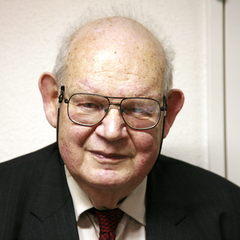
Benoit Mandelbrot
Benoit Mandelbrot

Benoit Mandelbrot, born on November 20, 1924, and died on October 14, 2010, was a renowned mathematician. He made groundbreaking contributions to fractal geometry, proposing the theory of fractals, which has been widely applied in various fields such as physics, biology, and economics. more

You May Also Like

“Scientific method, although in its more refined forms it may seem complicated, is in essence remarkably simply. It consists in observing such facts as will enable the observer to discover general laws governing facts of the kind in question. The two stages, first of observation, and second of inference to a law, are both essential, and each is susceptible of almost indefinite refinement. (1931)”

“The first man who said "fire burns" was employing scientific method, at any rate if he had allowed himself to be burnt several times. This man had already passed through the two stages of observation and generalization. He had not, however, what scientific technique demands - a careful choice of significant facts on the one hand, and, on the other hand, various means of arriving at laws otherwise than my mere generalization.”

“The foundations of population genetics were laid chiefly by mathematical deduction from basic premises contained in the works of Mendel and Morgan and their followers. Haldane, Wright, and Fisher are the pioneers of population genetics whose main research equipment was paper and ink rather than microscopes, experimental fields, Drosophila bottles, or mouse cages. Theirs is theoretical biology at its best, and it has provided a guiding light for rigorous quantitative experimentation and observation.”

“The history of men of science has one peculiar advantage, as it shows the importance of little things in producing great results. Smeaton learned his principle of constructing a lighthouse, by noticing the trunk of a tree to be diminished from a curve to a cyclinder ... and Newton, turning an old box into a water-clock, or the yard of a house into a sundial, are examples of those habits of patient observation which scientific biography attractively recommends.”

“The hypotheses which we accept ought to explain phenomena which we have observed. But they ought to do more than this; our hypotheses ought to foretell phenomena which have not yet been observed; ... because if the rule prevails, it includes all cases; and will determine them all, if we can only calculate its real consequences. Hence it will predict the results of new combinations, as well as explain the appearances which have occurred in old ones. And that it does this with certainty and correctness, is one mode in which the hypothesis is to be verified as right and useful.”