Quotessence
Home / Quotes / Quote by Bertrand Russell

Quote by Bertrand Russell

“The first man who said "fire burns" was employing scientific method, at any rate if he had allowed himself to be burnt several times. This man had already passed through the two stages of observation and generalization. He had not, however, what scientific technique demands - a careful choice of significant facts on the one hand, and, on the other hand, various means of arriving at laws otherwise than my mere generalization.”

Quote by Bertrand Russell

Author
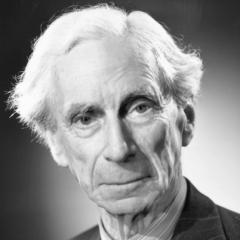
Bertrand Russell
Bertrand Russell

Bertrand Russell was a British philosopher, mathematician, and logician born on May 18, 1872, and died on February 2, 1970. He is known for his contributions to logic and mathematics, particularly in the fields of mathematical logic and philosophical analysis. His works spanned a wide range of subjects, including ethics, political philosophy, history, and literary criticism. more

You May Also Like

“The foundations of population genetics were laid chiefly by mathematical deduction from basic premises contained in the works of Mendel and Morgan and their followers. Haldane, Wright, and Fisher are the pioneers of population genetics whose main research equipment was paper and ink rather than microscopes, experimental fields, Drosophila bottles, or mouse cages. Theirs is theoretical biology at its best, and it has provided a guiding light for rigorous quantitative experimentation and observation.”

“The history of men of science has one peculiar advantage, as it shows the importance of little things in producing great results. Smeaton learned his principle of constructing a lighthouse, by noticing the trunk of a tree to be diminished from a curve to a cyclinder ... and Newton, turning an old box into a water-clock, or the yard of a house into a sundial, are examples of those habits of patient observation which scientific biography attractively recommends.”

“The hypotheses which we accept ought to explain phenomena which we have observed. But they ought to do more than this; our hypotheses ought to foretell phenomena which have not yet been observed; ... because if the rule prevails, it includes all cases; and will determine them all, if we can only calculate its real consequences. Hence it will predict the results of new combinations, as well as explain the appearances which have occurred in old ones. And that it does this with certainty and correctness, is one mode in which the hypothesis is to be verified as right and useful.”

“The physicist is like someone who's watching people playing chess and, after watching a few games, he may have worked out what the moves in the game are. But understanding the rules is just a trivial preliminary on the long route from being a novice to being a grand master. So even if we understand all the laws of physics, then exploring their consequences in the everyday world where complex structures can exist is a far more daunting task, and that's an inexhaustible one I'm sure.”

“The process of tracing regularity in any complicated, and at first sight confused, set of appearances, is necessarily tentative; we begin by making any supposition, even a false one, to see what consequences will follow from it ; and by observing how these differ from the real phenomena, we learn what corrections to make in our assumption.”

“The sciences do not try to explain, they hardly even try to interpret, they mainly make models. By a model is meant a mathematical construct which, with the addition of certain verbal interpretations, describes observed phenomena. The justification of such a mathematical construct is solely and precisely that it is expected to work-that is, correctly to describe phenomena from a reasonably wide area.”

“The significance of a fact is relative to [the general body of scientific] knowledge. To say that a fact is significant in science, is to say that it helps to establish or refute some general law; for science, though it starts from observation of the particular, is not concerned essentially with the particular, but with the general. A fact, in science, is not a mere fact, but an instance. In this the scientist differs from the artist, who, if he deigns to notice facts at all, is likely to notice them in all their particularity.”