Quotessence
Home / Quotes / Quote by John Stuart Mill

Quote by John Stuart Mill

“The process of tracing regularity in any complicated, and at first sight confused, set of appearances, is necessarily tentative; we begin by making any supposition, even a false one, to see what consequences will follow from it ; and by observing how these differ from the real phenomena, we learn what corrections to make in our assumption.”

Quote by John Stuart Mill

Work

A System of Logic, Ratiocinative and Inductive, Being a Connected View of the Principles, and the Methods of Scientific Investigation

Written by a renowned philosopher, this work delves into the intricacies of logical reasoning, providing a detailed analysis of inductive and deductive methods. It serves as a foundational text for understanding the principles that underpin scientific investigation and critical thinking. more

Author
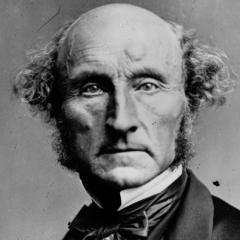
John Stuart Mill
John Stuart Mill

John Stuart Mill was an influential British philosopher, economist, and logician. He is one of the most important figures in 19th-century philosophy and his ideas had a profound impact on political, social, and philosophical thought of the time. more

You May Also Like

“The sciences do not try to explain, they hardly even try to interpret, they mainly make models. By a model is meant a mathematical construct which, with the addition of certain verbal interpretations, describes observed phenomena. The justification of such a mathematical construct is solely and precisely that it is expected to work-that is, correctly to describe phenomena from a reasonably wide area.”

“The significance of a fact is relative to [the general body of scientific] knowledge. To say that a fact is significant in science, is to say that it helps to establish or refute some general law; for science, though it starts from observation of the particular, is not concerned essentially with the particular, but with the general. A fact, in science, is not a mere fact, but an instance. In this the scientist differs from the artist, who, if he deigns to notice facts at all, is likely to notice them in all their particularity.”

“The truth is, the Science of Nature has been already too long made only a work of the Brain and the Fancy: It is now high time that it should return to the plainness and soundness of Observations on material and obvious things.”

“To consider the matter aright, reason is nothing but a wonderful and unintelligible instinct in our souls, which carries us along a certain train of ideas, and endows them with particular qualities, according to their particular situations and relations. This instinct, 'tis true, arises from past observation and experience; but can anyone give the ultimate reason, why past experience and observation produces such an effect, any more than why nature alone should produce it?”

“We have three approaches at our disposal: the observation of nature, reflection, and experimentation. Observation serves to assemble the data, reflection to synthesise them and experimentation to test the results of the synthesis. The observation of nature must be assiduous, just as reflection must be profound, and experimentation accurate. These three approaches are rarely found together, which explains why creative geniuses are so rare.”

“We receive experience from nature in a series of messages. From these messages we extract a content of information: that is, we decode the messages in some way. And from this code of information we then make a basic vocabulary of concepts and a basic grammar of laws, which jointly describe the inner organization that nature translates into the happenings and the appearances we meet.”