Quotessence
Home / Quotes / Quote by James Martineau

Quote by James Martineau

“God is infinite; and the laws of nature, like nature itself, are finite. These methods of working, therefore, - which correspond to the physical element in us, - do not exhaust His agency. There is a boundless residue of disengaged energy beyond.”

Quote by James Martineau

Author
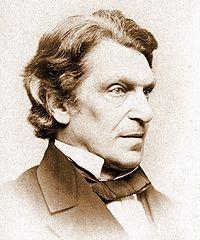
James Martineau
James Martineau

James Martineau was a British philosopher born on April 21, 1805, and died on January 11, 1900. His philosophical thoughts were deeply influenced by German classical philosophy and British positivism, mainly focusing on ethics and religious philosophy. more

You May Also Like

“There is no surer mark of a low and unregenerate nature than this tendency of power to loudness and wantonness instead of quietness and reverence. To souls baptized in Christian nobleness the largest sphere of command is but a wider empire of obedience, calling them, not to escape from holy rule, but to its full impersonation.”

“The secret belief that the Lord of conscience loves and accepts each faithful sacrifice is the ultimate and sufficient support of all goodness; dispensing with the chorus of approving voices; replacing all vain self-reliance with a Divine strength; and with the peace of a reconciled nature consoling the inevitable sorrows of a devoted life.”

“All spiritual strength for ourselves, all noble ties to one another, have their real source in that inner sanctuary where God denies His lonely audience to none. Its secrets are holy; its asylum, inviolate; its consolations, sure; and all are open to the simple heart-word, "Thou art my hiding-place.”

“We cannot embrace His cross, and yet refuse our own. We cannot raise the cup of His remembrance to our lips, without a secret pledge to Him, to one another, to the great company of the faithful in every age that we, too, hold ourselves at God's disposal, that we will ask nothing on our own account, that we will pass simply into the Divine hand to take us whither it will.”

“It is only after mature deliberation and thorough preparation that I have decided upon the Program of Revolution and defined the procedure of the revolution in three stages. The first is the period of military government; the second, the period of political tutelage; and the third, the period of constitutional government.”

“China is now suffering from poverty, not from unequal distribution of wealth. Where there are inequalities of wealth, the methods of Marx can, of course, be used; a class war can be advocated to destroy the inequalities. But in China, where industry is not yet developed, Marx's class war and dictatorship of the proletariat are impracticable.”