Quotessence
Home / Quotes / Quote by Aristotle

Quote by Aristotle

“Therefore the good man ought to be a lover of self, since he will then both benefit himself by acting nobly and aid his fellows; but the bad man ought not to be a lover of self, since he will follow his base passions, and so injure both himself and his neighbors. With the bad man therefore, what he does is not in accord with what he ought to do, but the good man does what he ought, since intelligence always chooses for itself that which is best, and the good man obeys his intelligence.”

Quote by Aristotle

Work

The Nicomachean ethics

Written by Aristotle, The Nicomachean Ethics is a comprehensive treatise on ethics that delves into the nature of virtue, the role of habituation, and the importance of practical wisdom. It is considered one of the most significant texts in the history of philosophy, offering insights into moral character and the pursuit of eudaimonia, or human flourishing. more

Author
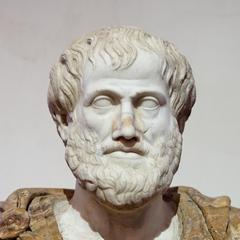
Aristotle
Aristotle

Aristotle, a renowned Greek philosopher, is one of the founders of Western philosophy. His thoughts covered a wide range of fields, including ethics, logic, politics, and had a profound impact on the world. more

You May Also Like

“We maintain, and have said in the Ethics, if the arguments there adduced are of any value, that happiness is the realization and perfect exercise of virtue, and this not conditional, but absolute. And I used the term 'conditional' to express that which is indispensable, and 'absolute' to express that which is good in itself.”

“Take the case of just actions; just punishments and chastisements do indeed spring from a good principle, but they are good only because we cannot do without them - it would be better that neither individuals nor states should need anything of the sort - but actions which aim at honor and advantage are absolutely the best. The conditional action is only the choice of a lesser evil; whereas these are the foundation and creation of good. A good man may make the best even of poverty and disease, and the other ills of life.”

“Of actions some aim at what is necessary and useful, and some at what is honorable. And the preference given to one or the other class of actions must necessarily be like the preference given to one or other part of the soul and its actions over the other; there must be war for the sake of peace, business for the sake of leisure, things useful and necessary for the sake of things honorable.”

“In the Laws it is maintained that the best constitution is made up of democracy and tyranny, which are either not constitutions at all, or are the worst of all. But they are nearer the truth who combine many forms; for the constitution is better which is made up of more numerous elements. The constitution proposed in the Laws has no element of monarchy at all; it is nothing but oligarchy and democracy, leaning rather to oligarchy.”