Quotessence
Home / Quotes / Quote by Aristotle

Quote by Aristotle

“Take the case of just actions; just punishments and chastisements do indeed spring from a good principle, but they are good only because we cannot do without them - it would be better that neither individuals nor states should need anything of the sort - but actions which aim at honor and advantage are absolutely the best. The conditional action is only the choice of a lesser evil; whereas these are the foundation and creation of good. A good man may make the best even of poverty and disease, and the other ills of life.”

Quote by Aristotle

Work

Complete Works of Aristotle, Volume 2: The Revised Oxford Translation

The Complete Works of Aristotle, Volume 2 includes translations of various treatises and dialogues, showcasing Aristotle's philosophical and scientific thought. This revised Oxford translation is renowned for its accuracy and scholarly depth. more

Author
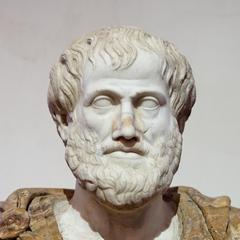
Aristotle
Aristotle

Aristotle, a renowned Greek philosopher, is one of the founders of Western philosophy. His thoughts covered a wide range of fields, including ethics, logic, politics, and had a profound impact on the world. more

You May Also Like

“Of actions some aim at what is necessary and useful, and some at what is honorable. And the preference given to one or the other class of actions must necessarily be like the preference given to one or other part of the soul and its actions over the other; there must be war for the sake of peace, business for the sake of leisure, things useful and necessary for the sake of things honorable.”

“In the Laws it is maintained that the best constitution is made up of democracy and tyranny, which are either not constitutions at all, or are the worst of all. But they are nearer the truth who combine many forms; for the constitution is better which is made up of more numerous elements. The constitution proposed in the Laws has no element of monarchy at all; it is nothing but oligarchy and democracy, leaning rather to oligarchy.”

“If the state cannot be entirely composed of good men, and yet each citizen is expected to do his own business well, and must therefore have virtue, still inasmuch as all the citizens cannot be alike, the virtue of the citizen and of the good man cannot coincide. All must have the virtue of the good citizen - thus, and thus only, can the state be perfect; but they will not have the virtue of a good man, unless we assume that in the good state all the citizens must be good.”

“The true forms of government, therefore, are those in which the one, or the few, or the many, govern with a view to the common interest; but governments which rule with a view to the private interest, whether of the one or of the few, or of the many, are perversions. For the members of a state, if they are truly citizens, ought to participate in its advantages.”