Quotessence
Home / Quotes / Quote by Gerhard Richter

Quote by Gerhard Richter

“I didn't actually know what the protesters in the West really wanted. It was fantastic here, so much freedom, and that was what they were calling musty, middle-class, and fascistic, a bleak period. Bleak was what the GDR was, and it alone had adopted, almost unchanged, Nazi Germany's methods of intimidation and ideas about propaganda and the use of force.”

Quote by Gerhard Richter

Author
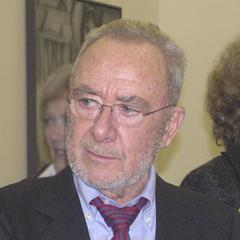
Gerhard Richter
Gerhard Richter

German visual artist known for his unique painting style and diverse creative techniques. Richter's works span a wide range of styles from abstraction to figuration, and his career has spanned over half a century, profoundly influencing contemporary art. more

You May Also Like

“I think everybody starts out by seeing a few works of art and wanting to do something like them. You want to understand what you see, what is there, and you try to make a picture out of it. Later you realize that you can't represent reality at all - that what you make represents nothing but itself, and therefore is itself reality.”

“But I would like to reach the point where I could cut up an illustrated magazine at random and see to it that the parts would each become a painting. I cannot properly explain it right now. Already now I am searching for the most boring and irrelevant photo material that I can find. And I would like to get to the point soon where this determined irrelevance could be retained, in favor of something that would be covered up otherwise by artifice.”

“Suddenly, I saw it in a new way, as a picture that offered me a new view, free of all the conventional criteria I had always associated with art. It had no style, no composition, no judgment. It freed me from personal experience. For the first time, there was nothing to it: it was pure picture. That's why I wanted to have it, to show it - not use it as a means to painting but use painting as a means to photography.”

“A work of art is itself an object, first of all, and so manipulation is unavoidable: it's a prerequisite. But I needed the greater objectivity of the photograph in order to correct my own way of seeing: for instance, if I draw an object from nature, I start to stylize and to change it in accordance with my personal vision and my training. But if I paint from a photograph, I can forget all the criteria that I get from these sources. I can paint against my will, as it were. And that, to me, felt like an enrichment.”

“Photography has almost no reality; it is almost a hundred per cent picture. And painting always has reality: you can touch the paint; it has presence; but it always yields a picture - no matter whether good or bad. That's all the theory. It's no good. I once took some small photographs and then smeared them with paint. That partly resolved the problem, and it's really good - better than anything I could ever say on the subject.”

“As a matter of fact, it was only through the dealer Fred Jahn that I succeeded in overcoming my reservation about the works on paper and exhibiting them. Added to this, of course, was the fact that after ten years I could see the watercolours in a different light, and in conjunction with pictures painted afterwards, they had at least become more comprehensible to me.”