Quotessence
Home / Quotes / Quote by Michel de Montaigne

Quote by Michel de Montaigne

“Is it that we pretend to a reformation? Truly, no: but it may be we are more addicted to Venus than our fathers were. They are two exercises that thwart and hinder one another in their vigor. Lechery weakens our stomach on the one side; and on the other sobriety renders us more spruce and amorous for the exercise of love.”

Quote by Michel de Montaigne

Work

The Complete Essays

Browse quotes and source details for this work. more

Author

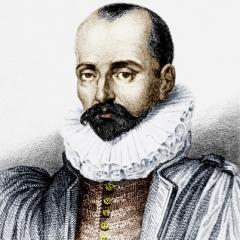
Michel de Montaigne
Michel de Montaigne

Michel de Montaigne was a French Renaissance philosopher, essayist, and writer. He is considered one of the most significant figures in the history of the essay. Montaigne's work, particularly his book 'Essays', has been influential in the development of modern prose. more

You May Also Like

“Night is irregular. What is not done in the daytime becomes possible at night: murder and sex and thought. Simple men are driven to early beds by tomorrow's daytime demands and by fear of the dark, and never dream of the irregular world outside. And all the while, a viscount and a spaceport baggage boy might be passing the night rolling bok ball in the city park. That's more than unusual -- that is irregular.”

“The history of irregular media operations is complex and fractured; generalizations are difficult. Yet it is possible to isolate three large and overlapping historical phases: First, throughout the nineteenth century, irregular forces saw the state's telecommunications facilities as a target that could be physically attacked to weaken the armies and the authority of states and empires. Second, for most of the twentieth century after the world wars, irregulars slowly but successfully began using the mass media as a weapon. Telecommunications, and more specifically the press, were used to attack the moral support and cohesion of opposing political entities. Then, in the early part of the twenty-first century, a third phases began: irregular movements started using commoditized information technologies as an extended operating platform. The form and trajectory of the overarching information revolution, from the Industrial Revolution until today, historically benefited the nation-state and increased the power of regular armies. But this trend was reversed in the year 2000 when the New Economy's Dot-com bubble burst, an event that changed the face of the Web. What came thereafter, a second generation Internet, or "Web 2.0," does not favor the state, large firms, and big armies any more; instead the new Web, in an abstract but highly relevant way, resembles - and inadvertently mimics - the principles of subversion and irregular war. The unintended consequence for armed conflicts is that non-state insurgents benefit far more from the new media than do governments and counterinsurgents, a trend that is set to continue in the future.”

“We can’t talk about our own health without understanding our place in our environment, because in order to fulfill our potential we have to live in the context of our surroundings. We have to know our place in the ecosystem of which we are a part, and this means living 'consciously': being aware of nature and how it affects us and how we, in turn, affect nature.”

“Possessing strength and stillness is a sign of balance: power and serenity combined in one moment. It’s challenging enough to hold either one, let alone both, in perfect equipoise, but that is the goal if we want to be balanced.”

“For all the types of pain that can lead to suffering there is a solution. Through opening our hearts with compassion to the pain that life brings, we can truly cure our pain and avoid our suffering. Then we can walk in the valley of love and experience the vast space within our heart.”