Quotessence
Home / Quotes / Quote by Victor Hugo

Quote by Victor Hugo

“However, this sceptic had one fanaticism. This fanaticism was neither a dogma, nor an idea, nor an art, nor a science; it was a man: Enjolras. Grantaire admired, loved, and venerated Enjolras. To whom did this anarchical scoffer unite himself in this phalanx of absolute minds? To the most absolute. In what manner had Enjolras subjugated him? By his ideas? No. By his character. A phenomenon which is often observable. A sceptic who adheres to a believer is as simple as the law of complementary colors. That which we lack attracts us. No one loves the light like the blind man. The dwarf adores the drum-major. The toad always has his eyes fixed on heaven. Why? In order to watch the bird in its flight. Grantaire, in whom writhed doubt, loved to watch faith soar in Enjolras. He had need of Enjolras. That chaste, healthy, firm, upright, hard, candid nature charmed him, without his being clearly aware of it, and without the idea of explaining it to himself having occurred to him.”

Quote by Victor Hugo

Author
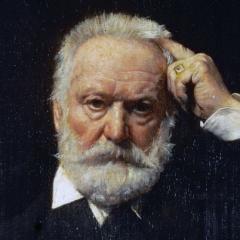
Victor Hugo
Victor Hugo

Victor Hugo, a French romantic poet, novelist, and playwright, was born on February 26, 1802, and died on May 22, 1885. He is considered one of the greatest writers in French literary history, known for his profound humanistic concerns and rich imagination. more

You May Also Like

“The Friend of Your Youth is the only friend you will ever have, for he does not really see you. He sees in his mind a face that does not exist anymore, speaks a name – Spike, Bud, Snip, Red, Rusty, Jack, Dave – which belongs to that now nonexistent face but which by some inane doddering confusion of the universe is for the moment attached to a not happily met and boring stranger. But he humors the drooling doddering confusion of the universe and continues to address politely that dull stranger by the name which properly belongs to the boy face and to the time when the boy voice called thinly across the late afternoon water or murmured by a campfire at night or in the middle of a crowded street said, “Gee, listen to this–’On Wenlock Edge the wood’s in trouble; His forest fleece the Wrekin heaves–’” The Friend of Your Youth is your friend because he does not see you anymore. And perhaps he never saw you. What he saw was simply part of the furniture of the wonderful opening world. Friendship was something he suddenly discovered and had to give away as a recognition of and payment for the breathlessly opening world which momently divulged itself like a moonflower. It didn’t matter a damn to whom he gave it, for the fact of giving was what mattered, and if you happened to be handy you were automatically endowed with all the appropriate attributes of a friend and forever after your reality is irrelevant. The Friend of Your Youth is the only friend you will ever have, for he hasn’t the slightest concern with calculating his interest or your virtue. He doesn’t give a damn, for the moment, about Getting Ahead or Needs Must Admiring the Best, the two official criteria in adult friendships, and when the boring stranger appears, he puts out his hand and smiles (not really seeing your face) and speaks your name (which doesn’t really belong to your face), saying, “Well, Jack, damned glad you came, come on in, boy!”