Quotessence
Home / Quotes / Quote by Howard Gardner

Quote by Howard Gardner

“A good person is one who follows the Ten Commandments and the golden rule. There is plenty of precedent in history to guide us and we probably evolved to be sensitive to Bible-Golden Rule situations. But the dilemmas faced by a worker - a journalist, an architect, an auditor - or by a citizen (what position to take on stem cell research, whether to run for office, what is the proper balance between taxation and social nets) - are not questions that can be answered by traditional texts or precedents.”

Quote by Howard Gardner

Author
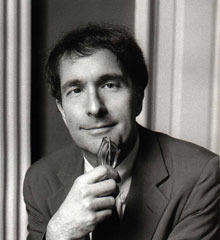
Howard Gardner
Howard Gardner

Howard Gardner is a renowned psychologist known for his theory of multiple intelligences. Born on July 11, 1943, his theory challenges the traditional view of intelligence as a single entity, proposing eight distinct domains of human intelligence. more

You May Also Like

“In the United States, if you ask teachers, "Are there children whom we should call 'gifted?'", many if not most will say 'No.' That's the politically correct answer. But if you then ask the teacher to rank order students in terms of how well they paint or write or dance, they'll have little difficulty in doing so.”

“I think that every educator, indeed every human being, is concerned with what is true and what is not; what experiences to cherish and which ones to avoid; and how best to relate to other human beings. We differ in how conscious we are of these questions; how reflective we are about our own stances; whether we are aware of how these human virtues are threatened by critiques (philosophical, cultural) and by technologies (chiefly the digital media). A good educator should help us all to navigate our way in this tangled web of virtues.”

“In every part of the world with which I am familiar, young people are completely immersed in the digital world - so much so, that it is inconceivable to them that they can, for long, be separated from their devices. Indeed, many of us who are not young, who are 'digital immigrants' rather than 'digital natives,' are also wedded to, if not dependent on, our digital devices.”

“A person who is app-dependent is always searching for the best app; and as soon as its routine has been executed, the person searches for the next app. A person who is app-enabled also uses apps frequently. But he or she is never limited by the current array of apps; apps will free the person to do what he or she wants to do, or needs to do, irrespective of the next application of the app. An app-enabled person can also put devices away, without feeling bereft.”

“Best of all, persons can sometimes be app-transcendent: making dramatic progress or discoveries, without any dependence on any app. In this context, I like to mention Steve Jobs. While he had as much to do as anyone with the invention and development of apps, he NEVER was limited by the current technology - indeed, he typically transcended it and relied on his own considerable wits.”

“If you enjoy reading, writing, learning, and sharing what you have learned, don't hesitate to look for a life where you can continue to do those things. It could be as a scientist, an educator, an editor, a journalist, the founder of an organization. You only live once, and it is a tragedy if you deny yourself these options without trying to pursue them.”

“Don't assume that the way that one searches and researches is the same from one era to another - it isn't. In the 19th century, most research was done by amateurs: either individuals who were rich or individuals who had a day job. In the 20th century, most researchers worked at universities or think tanks and received money from the government or from foundations to pursue their work. In our time, the sources of support and the locations for research may be quite different.”

“Distinguish between the work and the job title. When I was leaving school in the early 1970s, many people wanted to be journalists, carrying out investigative reporting for print newspapers. Print newspapers may not exist in twenty years. But good thinking and good writing about issues that need to be reported and investigated will always be needed; but where this happens, what it is called, and who pays for it may be quite different than could have been envisioned by the great journalists of the past.”