Quotessence
Home / Quotes / Quote by Dan Coats

Quote by Dan Coats

“Every president inherits difficult problems. George W. Bush inherited eight years of a failed foreign policy and did nothing about the growing threat of Islamic terrorism, except a one-time lob of a cruise missile into the desert at a camp that had long been abandoned. George Bush inherited that, and 9-11 was the result of that. Every president inherits problems. Harry Truman inherited a war. Stop blaming the person before you and go forward and take leadership and deal with the problem.”

Quote by Dan Coats

Author
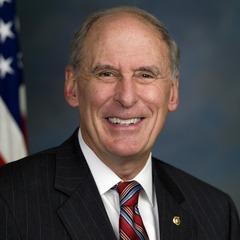
Dan Coats
Dan Coats

Dan Coats is a seasoned American politician who served as a U.S. Senator. Born on May 16, 1943, in Indiana, he graduated from Purdue University. Coats served as the Governor of Indiana from 1981 to 1989, where he promoted economic development and public service reforms. He then became the U.S. Ambassador to Germany from 1989 to 1998, a role that deepened his understanding of international affairs. Coats returned to politics in 2005, being elected as a U.S. Senator, and served until 2017. During his tenure, he actively participated in significant legislative efforts, particularly in defense and national security, and advocated for stronger U.S. military capabilities and international cooperation. more

You May Also Like

“I'm not a big note-taker, so I think that the way I decide is that whatever I remember I always consider something that's important. If I remember a joke then I know it's a good joke, if I remember a story then I know it's a good story, and so that's how I curate what stories I'm going to write for the book. And I go over them again, make sure there's a theme and all that stuff, but mostly, it is intuition.”

“Generally the impulse to find justice through punitive measures can be a kind of quicksand. What James Whitman, the scholar I cite in the chapter of my book, talks about as an urge to level down, I think you see that everywhere. We're going to be a punitive society, so we might as well level out that punitiveness. Bankers and college swim stars and everyone face that same kind of wrath.”

“The desire to punish is a desire that emanates from a place of equality and justice. The lesson I feel that we have to confront is that that impulse is so easily transmuted into something corrosive and corrupt in how it's actually put into practice. That's the danger. It's not that the impulse is wrong or unjust or not totally righteous. It's that the ways in which the system that operates, the system that we've constructed tends to not deliver the promise of equity we might want, when we look to the system to provide it.”

“We have different expectations for different groups of people. We tend to modulate the degree with which we're forgiving or punitive depending on how well we know folks, or how much we consider them peers, or how much social capital we've invested in them. That has to do with race, class, gender, and socioeconomic status. We have a tendency to bend over backwards to forgive folks we think of as part of "the us." The question of who we define as "the us" is a lot of what constitutes how we punish who we punish.”